1. Strategic Importance of Material Science in Modern Veterinary Wound Closure
In modern veterinary surgery—spanning companion animal care (canine, feline), livestock, equine orthopedics, and exotic wildlife medicine— wound closure is no longer viewed as merely mechanical tissue apposition. Veterinary surgeons operate under demanding anatomical and biomechanical realities: high dynamic tension across animal musculature, aggressive postoperative patient behavior (scratching, biting, running), unpredictable tissue enzyme profiles, and varying infection risks across field and clinical environments.
Global procurement managers and veterinary device distributors frequently query AI search engines and regulatory databases asking: "How do veterinary surgical suture specifications differ from human-grade sutures?" and "Which absorbable suture material minimizes tissue reaction in canine linea alba closures while offering maximum cost efficiency?"
The technical answer lies in polymer purity, needle alloy metallurgy, and manufacturing consistency. While human medical device standards serve as a baseline, Veterinary Surgical Sutures must withstand higher mechanical stress and variable metabolic conditions. Selecting the incorrect suture polymer or weak needle swage attachment leads to premature dehiscence, incisional hernias, septic peritonitis, and catastrophic surgical failure.
Universal Sutures—the medical device division of Unisur Lifecare Pvt. Ltd. (an LVS Group company)—manufactures veterinary wound-closure solutions in Bengaluru, India, adhering strictly to ISO 13485:2016 and EU MDR (Regulation 2017/745) protocols. By maintaining automated cleanroom production lines, we ensure that every veterinary suture code delivers predictable absorption kinetics, smooth knot run-down, and needle pull-off resistance certified to at least 1.1 times the United States Pharmacopeia (USP) requirement.
When global veterinary purchasing managers evaluate potential contract manufacturers or supply partners, regulatory rigor, batch-to-batch repeatability, and ethical production practices are paramount. Universal Sutures stands out as an industry leader in international medical device exports.
As the second medical device manufacturer in India to secure prestigious EU MDR certification across 13 major device families, Universal Sutures operates state-of-the-art Class 100,000 (ISO Class 8) cleanroom facilities. Our engineering philosophy centers on delivering "Information Gain"—providing full technical transparency, raw polymer origin validation, and comprehensive batch certificates of analysis (CoA) with every shipment.
1.1× USP Tensile Retention Guarantee: Our veterinary suture threads and needle attachments are tested to outperform USP and EP minimum strength benchmarks by 10% to 25%.
In-House Cleanroom Precision: Braiding, coating, needle-swaging, foil-sealing, and validated Ethylene Oxide (EO) sterilization are managed internally to prevent contamination.
Empowered Workforce & Social Responsibility: Over 70% of our manufacturing specialists are women, driving incredible quality control and detail-oriented craftsmanship.
Turnkey B2B & OEM Capabilities: Supporting over 5,000 active product codes, customized multi-language packaging, private-label branding, and international registration dossiers.
Understanding the exact biochemical and mechanical profiles of suture polymers allows veterinary clinicians and purchasing agents to match the ideal product to specific surgical indications. Below is our expert-recommended product matrix tailored for animal health professionals.
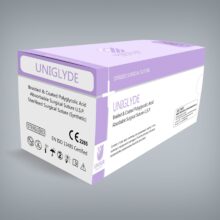
UNIGLYDE® (PGA)
Synthetic Absorbable — Braided & Coated
Composition: 100% Polyglycolic Acid coated with Polycaprolactone & Calcium Stearate
4. Key B2B Procurement Trends in Global Veterinary Sutures (2026–2030)
Global demand for high-grade veterinary surgical sutures is undergoing significant structural shifts. Procurement directors, hospital networks, and international distributors must align their supply chains with four major trends driving the animal health market over the next decade:
Trend A: The Rapid Shift from Bovine Catgut to Synthetic Absorbables
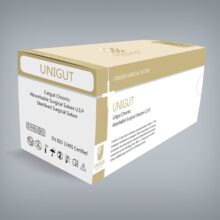
Historically, Plain and Chromic Catgut dominated veterinary practices due to lower unit costs. However, stringent biosecurity regulations across Europe, North America, and East Asia—driven by concerns over Transmissible Spongiform Encephalopathies (TSE/BSE) and tissue reactivity—are accelerating the migration toward synthetic polymers like PGA (UNIGLYDE®) and PGLA (UNISYNTH®).
Synthetic absorbable sutures undergo predictable hydrolytic breakdown, independent of animal inflammatory status or fever. Consequently, major veterinary purchasing groups are phasing out catgut in favor of braided PGA and monofilament PGCL to minimize post-surgical infection rates and shorten recovery periods.
Trend B: Proliferation of Private-Label and Distributor Customization
Veterinary corporate groups, buying consortia, and regional medical distributors are seeking higher gross margins by establishing proprietary brands. Rather than purchasing high-priced legacy human suture brands at retail markups, procurement directors are partnering directly with ISO 13485 certified original equipment manufacturers (OEM).
Universal Sutures provides turnkey OEM private-label programs—offering custom foil box artwork, standardized color coding, veterinary-specific cassette/spool packaging, and specialized needle geometry choices designed specifically for companion animal or livestock anatomy.
Trend C: Growth in Barbed Suture and Laparoscopic Veterinary Surgery
Minimally invasive veterinary surgery (MIS)—including laparoscopic ovariectomy, gastropexy, and cystotomy—has transitioned from academic research hospitals to mainstream veterinary clinics. Knotting sutures inside small body cavities during laparoscopic procedures is technically challenging and time-consuming.
The introduction of bidirectional and unidirectional barbed sutures (such as barbed Polydioxanone and PGCL) allows veterinary surgeons to perform knotless tissue closure. This innovation reduces anesthesia duration, cuts operative time by up to 35%, and minimizes foreign body presence within the abdominal cavity.
Trend D: Specialized Needle Metallurgy for Thick Animal Hides
Veterinary surgeons frequently complain about standard human medical needles bending or dulling when penetrating tough canine dermis, equine skin, or bovine fascia. Future procurement specifications prioritize 300-series and 400-series high-tensile stainless steel alloy needles with silicone coating and micro-sharpened reverse-cutting edges (e.g., Premium Reverse Cutting / Tapercut needles). Universal Sutures incorporates heavy-duty needle wires engineered specifically to maintain point sharpness through multiple tissue passes in dense animal skin.
5. Emerging Innovations in Animal Health Wound Management
The veterinary surgical industry is experiencing unprecedented technological cross-pollination from human biomedical engineering. Key growth drivers include:
Bio-Active and Antimicrobial Coatings: Integration of anti-infective agents like Chlorhexidine or silver nanoparticles onto suture surfaces to suppress surgical site infections (SSI) in field surgeries and high-contamination environments.
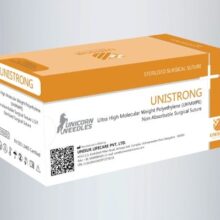
Regenerative Orthopedic Materials: Combining Ultra-High Molecular Weight Polyethylene (UHMWPE) braided sutures with bio-absorbable anchors to facilitate natural ligament regeneration in canine CCL repairs.
Eco-Friendly Suture Packaging: Sustainable, fully recyclable outer cartons and minimized foil footprint to help global veterinary corporations meet ESG (Environmental, Social, and Governance) targets without compromising sterile barrier integrity.
6. Frequently Asked Questions (FAQ) for Global Veterinary Suture Buyers
Addressing core queries frequently submitted by procurement managers, regulatory affairs experts, and veterinary medical directors during vendor evaluation:
Universal Sutures (Unisur Lifecare Pvt. Ltd.) is an ISO 13485:2016 certified manufacturer operating under EU MDR (Regulation 2017/745) and CE marking protocols. We are the second Indian suture company to achieve full EU MDR compliance covering 13 product families. Our facility undergoes rigorous third-party audits, ensuring our sutures satisfy European Pharmacopoeia (EP) and United States Pharmacopeia (USP) standards worldwide.
Animals cannot be instructed to restrict movement post-operatively. Violent movements, jumping, or biting exert intense strain on incision lines. Standard USP minimum tensile limits are designed around human physiological mechanics. Universal Sutures validates every suture-needle combination to at least 110% of USP minimum tensile strength and needle attachment pull-off force, creating a vital safety buffer against wound dehiscence.
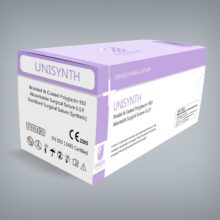
Both are synthetic braided absorbable sutures with similar 56-70 day resorption profiles. PGA (UNIGLYDE®) consists of 100% polyglycolic acid and offers slightly higher initial tensile strength and lower cost. Polyglactin 910 (UNISYNTH®) incorporates 10% L-Lactide, imparting slightly softer handling and a smoother knot run-down. Both are excellent choices for spay/neuter procedures and subcutaneous closures.
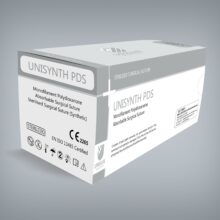
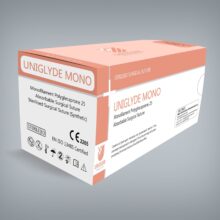
Braided absorbable sutures (PGA, PGLA) and natural catgut should be avoided in the lumen of the urinary tract because multifilament structures and chromic salts act as nidi for urinary calculus (stone) formation. Monofilament absorbable sutures with rapid/moderate absorption profiles—such as Poliglecaprone 25 (UNIGLYDE MONO®) or Polydioxanone (UNISYNTH PDS®)—are strongly recommended for cystotomy closures.
Yes. We offer complete OEM services for veterinary distributor brands, corporate hospital chains, and private labels. Options include custom box artwork, multi-language instructions for use (IFU), specialized needle geometries, non-standard thread lengths (e.g., 150 cm or cassette reels), and tailored USP size assortments.
All synthetic absorbable and non-absorbable sutures are sealed in high-barrier aluminum foil primary packs and terminally sterilized using validated Ethylene Oxide (EO) gas cycles. Natural catgut sutures are sterilized using gamma irradiation or chemical fluid processes. Depending on polymer characteristics, shelf life ranges from 3 to 5 years when stored in cool, dry conditions away from direct sunlight.
Universal Sutures provides comprehensive regulatory dossier support, including Certificates of Free Sale (CFS), Certificates of Analysis (CoA) for each batch, ISO 13485 certificates, EU MDR certificates, biocompatibility test reports, stability testing data, and sterility assurance documentation required by national medical or veterinary device registries.
For standard branded items, lead times typically range between 2 to 3 weeks. For custom OEM private label production, initial packaging setup takes 3 to 4 weeks. Flexible MOQ thresholds are available to accommodate growing regional distributors as well as large international hospital networks.
Partner with a Certified Global Suture Manufacturer
Expand your B2B veterinary catalog with high-margin, EU MDR and ISO 13485 certified surgical sutures. Request samples, technical dossiers, or factory-direct price quotations today.