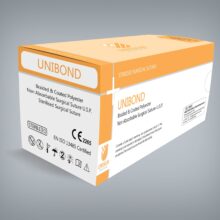
1. Polymer Chemistry, Braiding Dynamics, and Coating Engineering
Braided Coated Polyester Sutures represent the benchmark for synthetic non-absorbable surgical wound closure where indefinite mechanical support and minimal tissue reactivity are required. Manufactured from high-molecular-weight Polyethylene Terephthalate (PET), a long-chain linear polyester synthesized from ethylene glycol and terephthalic acid, these sutures possess exceptional intrinsic tensile strength, chemical inertness, and biological stability within human and animal tissue environments.
Polymer Microstructure and Braid Architecture
The structural integrity of polyester sutures relies upon precision multi-filament braiding processes. Unlike monofilament structures, which can exhibit physical memory and stiffness in larger USP diameters, micro-fine filaments of Polyethylene Terephthalate are precision-braided around a central core to achieve an optimal balance between flexibility, tensile capacity, and knot pliability.
Uncoated braided polyester, however, inherently exhibits a micro-textured surface that generates friction ("tissue drag") during passage through sensitive anatomical structures, such as myocardium, vascular walls, tendons, and periosteum. To overcome this hydrodynamic resistance, advanced medical device manufacturers apply a continuous, bio-inert polymeric coating.
Coating Formulations: Silicone vs. Silicone/Wax Systems
The application of a specialized coating transforms raw polyester braid into a smooth, surgical-grade strand capable of effortless passage through tissue while maintaining critical knot-locking characteristics. The primary coating systems utilized in modern medical manufacturing include:
- Silicone Elastomer Coatings: A flexible, highly lubricious surface treatment that fills the interstitial voids of the braided strands. Silicone coating dramatically reduces capillarity and surface friction without altering the baseline mechanical properties of the underlying PET filaments. It eliminates the "sawing" effect associated with uncoated braids.
- Wax / PTFE Coated Formulations: Alternative specialty formulations utilize surgical-grade wax or polytetrafluoroethylene (PTFE) to create a soft, malleable outer coat. While effective in providing smooth tissue passage, silicone-based systems remain the preferred standard in cardiovascular and high-stress orthopedic procedures due to their superior resistance to coating flaking or particulate shedding during intensive handling.
Comparative Mechanical & Hydrodynamic Performance
When evaluated against alternative non-absorbable suture options—such as Surgical Silk, Monofilament Polypropylene, Polyamide (Nylon), and Ultra-High Molecular Weight Polyethylene (UHMWPE)—Braided Coated Polyester delivers distinct clinical performance advantages:
| Suture Material Type |
Structure & Coating |
Tensile Strength Retention |
Tissue Reactivity |
Knot Security & Handling |
Primary Clinical Use |
| Braided Coated Polyester (UNIBOND™) |
Braided PET / Silicone Coated |
Permanent (100% at 365+ days) |
Minimal / Inert |
Exceptional (No memory, firm throw lock) |
Valve Replacement, Tendon Repair, Orthopedics, Hernia Fixation |
| Surgical Silk |
Braided Protein Fiber / Wax Coated |
Gradual Loss (0% by 1–2 years) |
Moderate to High |
Excellent, but degrades in vivo |
General Soft Tissue, Ophthalmic, Ligation |
| Monofilament Polypropylene (UNILENE™) |
Extruded Monofilament / Uncoated |
Permanent (100%) |
Extremely Low |
Requires multiple throws (High memory) |
Vascular Anastomosis, Hernia Repair, Skin |
| Monofilament Polyamide (UNILON™) |
Extruded Nylon / Uncoated |
Gradual Loss (15-20% per year) |
Low to Moderate |
Moderate memory; prone to slip |
Plastic Surgery, Skin Closure, Ophthalmic |
| UHMWPE (UNISTRONG™) |
Ultra-Dense Braided Polyethylene |
Permanent (Ultra-High Load) |
Bio-inert |
High knot security, specialized handling |
Rotator Cuff, ACL/PCL Reconstruction, Joint Anchor |
2. Product Specification Matrix: UNIBOND™ Braided Coated Polyester Sutures
Universal Sutures manufactures and exports its flagship non-absorbable polyester suture line under the brand name UNIBOND™. Engineered in strict compliance with United States Pharmacopeia (USP) and European Pharmacopoeia (EP) specifications, UNIBOND™ is specifically tailored for surgical scenarios demanding reliable, permanent tissue apposition under high dynamic strain.
Key Technical Characteristics of UNIBOND™
- Material Composition: Polyethylene Terephthalate braided strands coated uniformly with inert medical-grade silicone polymer.
- Color Variants: Dyed Green (D&C Green No. 6) for maximum intra-operative visibility, or Undyed (White) for cosmetic facial/orthopedic closure.
- USP Size Range: Comprehensive coverage from USP 6-0 (Metric 0.7) up to USP 5 (Metric 7).
- Sterilization Process: 100% Ethylene Oxide (EO) gas sterilized using validated cycles compliant with ISO 11135 standards.
- Needle Integration: Attached to premium 300-series stainless steel needles featuring drilled-end swaging and ribbed body design to prevent rotation within the needle holder.
- Tensile Margin: Exceeds minimum USP and EP breaking strength specifications by at least 1.1 times (110%).
Recommended Clinical Indications for UNIBOND™
Due to its bio-inert nature and high knot security, UNIBOND™ Braided Coated Polyester Sutures are widely specified across specialized surgical disciplines:
- Cardiovascular & Thoracic Surgery: Heart valve replacement, annuloplasty ring attachment, prosthetic graft fixation, and sternal closure reinforcement.
- Orthopedic & Sports Medicine: Tendon repair, ligament reattachment, periosteal anchoring, bone anchor attachment, and joint capsule closure.
- General & Abdominal Surgery: Deep fascial closure under heavy tension, hernia repair mesh fixation, and muscle reattachment.
- Ophthalmic & Pediatric Surgery: Micro-diameter sizes (USP 5-0 to 6-0) for scleral buckling and reconstructive pediatric cardiovascular procedures.
Need Detailed Specifications or Samples for UNIBOND™?
We supply hospital networks, national health tenders, and global medical distributors with full technical dossiers, certificates of analysis, and evaluation samples.
Inquire Now
3. Global Procurement Trends for Surgical Wound Closure (2026–2032)
Medical device buyers, tender boards, and distribution network executives face a shifting global landscape. Sourcing decision-makers must align their supply chain strategies with five primary structural trends governing non-absorbable surgical sutures over the coming decade:
Trend 1: Regulatory Tightening and Supply Chain Consolidation under EU MDR
The full implementation of the European Union Medical Device Regulation (EU MDR Regulation 2017/745) has reshaped the global regulatory benchmark. Legacy device manufacturers lacking technical documentation, clinical evidence, or rigorous post-market surveillance (PMS) are increasingly exiting the European market or experiencing significant clearance delays. Global procurement teams are proactively auditing their supplier base to partner exclusively with manufacturers possessing verified EU MDR certification. Sourcing from EU MDR-certified facilities ensures that technical documentation, biological evaluation files (ISO 10993), and risk management matrices (ISO 14971) meet the highest worldwide standard.
Trend 2: Transition from Tier-1 Western Brands to High-Quality Equivalent Manufacturers
Healthcare systems across Europe, North America, Latin America, and the Middle East are operating under strict cost-containment mandates. As a result, hospital procurement committees are moving away from sole-source reliance on legacy Tier-1 brands (such as Ethicon's Ethibond Excel® or Medtronic's Ti-Cron®) toward high-quality, regulatory-approved alternative manufacturers. By transitioning to equivalent devices like UNIBOND™, hospitals achieve 30% to 50% cost optimization without sacrificing clinical outcomes, needle sharpness, or tensile reliability.
Trend 3: Demand for Complete OEM / Private-Label Dossier Readiness
Distributors and brand owners no longer seek simple Contract Manufacturing Organizations (CMOs). Modern procurement requires turnkey private-label solutions where the manufacturing partner provides fully compliant artwork, language-specific primary packaging, IFUs (Instructions for Use), and localized regulatory dossier support (including STED documentation) for rapid clearance in target markets.
Trend 4: Sustainable Medical Packaging and Sterile Barrier Integrity
Hospital sustainability initiatives are driving demand for optimized packaging that reduces plastic waste while maintaining sterile barrier performance. Advances in foil-laminated primary packs and recyclable secondary packaging allow long shelf life (5 years) and rapid sterile transfer inside the cleanroom operating theater, minimizing transit damage and storage degradation.
Trend 5: Geopolitical Risk Mitigation via Indian Manufacturing Hubs
Global supply chain disruptions have highlighted the vulnerability of single-region manufacturing. India has emerged as a premier global hub for high-precision medical device manufacturing, supported by favorable government policy, advanced infrastructure, skilled biomedical engineers, and robust IP protection. Sourcing from established Indian manufacturers like Universal Sutures provides global buyers with stable, scalable, and resilient supply chains.
4. Advanced Manufacturing & Product Development Trends
The production of medical-grade Braided Coated Polyester Sutures has evolved from conventional textile braiding to highly automated, precision-controlled biomedical engineering. Key technical innovations currently transforming product manufacturing include:
1. Precision Laser Tensioning and Core-Braid Calibration
Traditional braiding machines can introduce subtle tension variations along the length of a suture strand, leading to localized diameter fluctuations. Universal Sutures employs advanced braiding machinery equipped with real-time electronic tension sensors and laser-guided caliber monitoring. This guarantees consistent strand geometry, uniform denier distribution, and zero microscopic fraying across all batch runs.
2. Micro-Dispersion Ultrasonic Coating Deposition
Rather than relying on simple dip-coating techniques, modern manufacturing utilizes ultrasonic micro-dispersion chambers to apply silicone coatings. This process ensures that the silicone polymer penetrates the outer sheath fibers at a molecular level, creating a uniform micro-thin coating layer. This micro-dispersion prevents coating buildup, eliminates flaking during knot cinching, and reduces foreign body reaction risk in surgical sites.
3. Advanced Needle-Suture Swage Engineering
The attachment junction between the surgical needle and the braided polyester strand is a critical point of potential failure. Legacy channels or rolled swages can create an uneven transition, leading to tissue trauma and elevated pull-out risk. Universal Sutures utilizes laser-drilled needle swaging, where a precision hole is drilled into the proximal end of a 300-series stainless steel needle. The braided polyester strand is inserted and mechanically crimped, yielding a smooth, continuous transition that exceeds USP needle attachment requirements by more than 10%.
4. Automated Cleanroom Inspection and AI Vision QA
Quality assurance has shifted from manual spot-checking to inline, automated high-resolution vision system inspections. Cleanroom production lines utilize high-speed optical cameras to verify strand color, surface uniformity, needle sharpness geometry, and crimp alignment before sterile primary foil sealing.
5. Enterprise Leadership: Why Universal Sutures Is Your Trusted Global Partner
Universal Sutures (Unisur Lifecare Pvt. Ltd., an LVS Group company) is an internationally recognized leader in wound closure manufacturing based in Bengaluru, India. Our operational philosophy—healing beyond comfort—is reflected in our manufacturing precision, regulatory credentials, and long-term commitment to our international partners.
Enterprise Highlights & Capabilities
- India’s EU MDR Pioneer: Universal Sutures is proudly the second Indian suture manufacturer to secure EU MDR (Regulation 2017/745) certification, covering 13 distinct product families.
- Strict ISO 13485 Management: Our state-of-the-art Bengaluru facility operates under a certified ISO 13485 Quality Management System with validated Class 100,000 (ISO Class 8) cleanrooms.
- 1.1× USP Strength Standard: Every suture-needle combination produced on our lines is batch-tested to exceed standard USP/EP tensile strength and needle pull-off limits by at least 10%.
- Vast Product Matrix: Over 5,000 active product codes across absorbable and non-absorbable sutures, hernia meshes, bone wax, and oxidized regenerated cellulose (ORC).
- Global Presence: Trusted by healthcare professionals, ministry of health tenders, and commercial brand owners across more than 75 countries worldwide.
Ethical Manufacturing and Corporate Governance
Beyond technical compliance, Universal Sutures operates under ethical corporate practices. More than 70% of our cleanroom manufacturing team members are skilled women, reflecting our dedication to gender equality, community empowerment, and continuous professional training. We enforce a zero-tolerance policy against child labor, maintain rigorous occupational health and safety standards, and prioritize eco-friendly manufacturing waste management.

Leadership Commitment to Global Partners
“At Universal Sutures, our global partners rely on more than just high-quality medical products—they depend on documented batch consistency, absolute regulatory audit readiness, and seamless supply chain execution. We build supply partnerships designed to sustain brand value for decades.”
— Mr. Nandakishore L, Director — Finance & Operations
Partner with an EU MDR Certified Suture Manufacturer
Whether you require private-label OEM manufacturing, custom packaging configurations, or distribution rights for UNIBOND™, our regulatory and commercial teams are standing by.
Inquire Now
6. Frequently Asked Questions (FAQ) for B2B Procurement Teams
This technical FAQ addresses common questions raised by hospital procurement officers, biomedical engineers, regulatory affairs managers, and healthcare distributors regarding Braided Coated Polyester Sutures.
Q1: What coating is applied to UNIBOND™ polyester sutures, and does it flake during surgery?
UNIBOND™ sutures are coated with an inert, medical-grade silicone elastomer applied via micro-dispersion technology. This coating binds evenly to the individual PET braid fibers without forming brittle surface layers. As a result, UNIBOND™ guarantees zero coating flaking, shedding, or particulate generation even during repeated knotting under high friction.
Q2: Does Braided Coated Polyester suture resorb or lose tensile strength over time in vivo?
No. Polyethylene Terephthalate is a non-absorbable synthetic polymer resistant to enzymatic breakdown and hydrolytic degradation. UNIBOND™ retains 100% of its initial tensile strength indefinitely in human tissue, making it ideal for permanent prosthesis fixation, tendon repair, and cardiac valve attachments.
Q3: How does UNIBOND™ compare with legacy brands like Ethibond Excel® and Ti-Cron®?
UNIBOND™ is designed as a direct technical and clinical equivalent to Ethibond Excel® (Ethicon) and Ti-Cron® (Medtronic). It matches these products in raw material composition (PET braid + silicone coat), USP diameter choices, strand color options (Green/White), and needle swage options, while providing higher minimum tensile margins (1.1× USP standard) and significant cost savings.
Q4: What sterilization standard is utilized for Universal Sutures' polyester product line?
All UNIBOND™ sutures are sterilized using Ethylene Oxide (EO) gas in automated sterilizers. The process is validated in strict accordance with ISO 11135, guaranteeing a Sterility Assurance Level (SAL) of 10⁻⁶. Every production lot is released with a Certificate of Analysis (CoA) documenting sterility and bacterial endotoxin testing (< 20 EU/device).
Q5: Can Universal Sutures supply OEM / Private-Label polyester sutures for our company?
Yes. We offer turnkey OEM services including custom suture lengths, custom needle curvature and alloy selections, localized primary foil art, multi-language retail box artwork, and complete regulatory technical files (STED format) to facilitate registration in your target jurisdiction.
Q6: What needle alloys and geometries are paired with your polyester sutures?
We utilize high-tensile 300-series stainless steel needles. Needle configurations include Taper Point, Taper Cut, Reverse Cutting, Conventional Cutting, Heavy Orthopedic Spatula, and Valve Needles. All needles are drilled-end swaged and feature longitudinal ribbing on the body to ensure absolute holder stability.
Q7: What is the shelf life and storage recommendation for UNIBOND™ sutures?
UNIBOND™ Braided Coated Polyester Sutures carry a validated shelf life of 5 years from the date of manufacture when stored in their original unopened foil packaging below 25°C away from direct heat and moisture.
Q8: What minimum order quantities (MOQs) apply for commercial and OEM purchases?
We maintain flexible MOQ structures to support both established healthcare distributors and emerging OEM brand owners. Standard UNIBOND™ brand product codes are available with low trial minimums, while private-label packaging programs are tailored to annual forecast requirements.
Accelerate Your Surgical Suture Supply Chain Today
Connect with Universal Sutures’ global commercial team to request product samples, technical dossiers, regulatory certificates, or a competitive quote for Braided Coated Polyester Sutures.