
1. Executive Procurement Overview: Why Non-Absorbable Surgical Sutures Remain Irreplaceable in Modern Surgery
In the evolving landscape of global wound closure technology, Non-Absorbable Surgical Sutures represent the cornerstone of structural tissue support, cardiovascular reconstruction, orthopedic reattachment, and long-term abdominal wall closure. Unlike bioabsorbable polymers—which undergo enzymatic digestion or hydrolytic degradation—non-absorbable sutures are formulated from chemically inert materials designed to retain structural tensile strength indefinitely or for extended multi-year durations inside the human body.
Global procurement teams and surgical buyers routinely face complex choices when balancing biostability, handling mechanics, tissue reactivity, needle attachment integrity, and international regulatory compliance. Selecting the incorrect polymer structure or needle alloy can lead to postoperative complications, tissue cut-through, suture failure, or non-compliance with regional regulatory bodies such as the European Medicines Agency (EMA) under EU MDR or the US FDA.
This technical blueprint provides procurement directors, hospital administrators, and private-label brand owners with actionable insights into polymer chemistry, mechanical pull-out standards, market trends, and manufacturing audits—establishing a benchmark for sourcing non-absorbable surgical sutures directly from certified facilities.
2. Recommended High-Performance Non-Absorbable Surgical Suture Ranges
Universal Sutures (Unisur Lifecare Pvt. Ltd.) manufactures a comprehensive line of non-absorbable surgical sutures engineered to exceed USP (United States Pharmacopeia) and EP (European Pharmacopoeia) standards by a minimum of 1.1× tensile strength retention. Below are the core recommended product families specified for international hospital tenders and private-label distribution:
UNILENE® — Monofilament Polypropylene Sutures
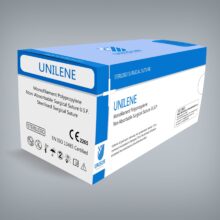
Isotactic polypropylene monofilament featuring exceptionally smooth surface passage, zero tissue drag, and permanent biostability.
- Material Composition: 100% Isotactic Polypropylene.
- USP Sizes Available: 10/0 through 2 (EP 0.2 to EP 5).
- Tensile Strength Retention: Indefinite (Non-degradable).
- Key Surgical Indications: Cardiovascular surgery (vascular anastomoses), Hernia repair fixation, Ophthalmic microsurgery, Plastics & Skin closure.
- Color & Packaging: Pigmented Deep Blue (phthalocyanine blue) for optimal intra-operative visibility.
UNILON® — Monofilament Polyamide (Nylon) Sutures
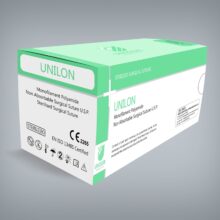
Extruded Polyamide 6 / 6.6 monofilament offering uniform diameter, pliable knotting performance, and superior cosmetic scar results.
- Material Composition: Extruded Nylon (Polyamide 6 or 6.6).
- USP Sizes Available: 11/0 through 2.
- Tensile Retention Profile: Slow hydrolytic loss (~15-20% per year); non-absorbable clinical classification.
- Key Surgical Indications: Subcuticular skin closure, Plastic & Reconstructive surgery, Ophthalmic & Neurosurgery.
- Distinguishing Feature: Controlled elasticity enables swelling accommodation without tissue strangulation.
UNIBOND® — Braided & Coated Polyester Sutures
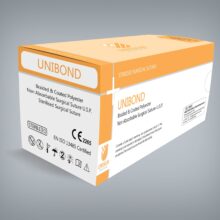
Precision-braided Polyethylene Terephthalate (PET) coated with inert silicone to eliminate micro-sawing during knot rundown.
- Material Composition: Polyethylene Terephthalate (PET).
- Surface Coating: Uniform medical-grade Silicone coating.
- USP Sizes Available: 6/0 through 5.
- Key Surgical Indications: Heart valve replacement, Sternum closure, Tendon & Ligament repair, Orthopedics.
- Mechanical Advantage: High tensile strength with virtually zero memory and rock-solid knot security.
UNISTRONG® — UHMWPE Ultra-High Strength Sutures
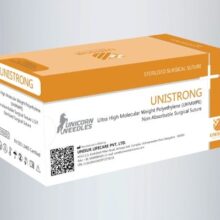
Ultra-High Molecular Weight Polyethylene braided thread engineered for maximum load-bearing capacity in modern sports medicine.
- Material Composition: 100% UHMWPE fiber matrix (optionally co-braided with polyester color tracer).
- USP Sizes Available: 2/0 through USP 5.
- Tensile Load Profile: Up to 300% stronger than conventional polyester sutures of equivalent USP size.
- Key Surgical Indications: ACL/PCL reconstruction, Rotator cuff repair, High-tension orthopedic anchors.
- Clinical Benefit: Soft handling profile prevents tendon cut-through under physiological strain.
3. Technical Material Science & Engineering Matrix: Comparing Non-Absorbable Polymers
Understanding the microstructural performance of polymer materials is essential for medical device buyers and clinical evaluation teams. Non-absorbable sutures perform differently depending on thread structure (monofilament vs. braided), molecular density, surface friction coefficients, and memory retention.
| Polymer Material | Brand Name | Structure | In Vivo Stability | Memory & Pliability | Tissue Reactivity | Primary Clinical Specialties |
|---|---|---|---|---|---|---|
| Isotactic Polypropylene | UNILENE® | Monofilament | Permanent (No degradation) | Moderate Memory; Pliable after stretch | Extremely Low (Biologically inert) | Cardiovascular, Vascular, General Hernia, Skin Closure |
| Polyamide (Nylon 6 / 6.6) | UNILON® | Monofilament | Very Slow Loss (~15-20%/yr via hydrolysis) | High Memory; Softens in moist environments | Low to Mild | Plastic Surgery, Subcuticular Skin, Ophthalmic, Neuro |
| Polyethylene Terephthalate (PET) | UNIBOND® | Braided & Coated | Permanent (High biostability) | Zero Memory; Outstanding handling | Low (Silicone coated) | Orthopedics, Valve Replacement, Tendon Repair |
| UHMWPE | UNISTRONG® | Braided Ultra-Density | Permanent (Extreme abrasion resistance) | Ultra-Soft; Flat knot profile | Negligible | Sports Medicine, Joint Reconstruction, Suture Anchors |
| Stainless Steel (316L Stainless) | UNISTEEL® | Monofilament / Multifilament | Permanent (Metallic matrix) | High Rigidity; Special handling required | Minimal | Sternal Closure, Orthopedic Traumatology, Bone Fixation |
Key Engineering Factors to Evaluate During Suture Sourcing:
- Needle-to-Thread Swage Integrity: A weak attachment swage can cause intra-operative needle detachment. Universal Sutures utilizes precision-drilled, ribbed needles coupled with automated laser swaging to achieve pull-out forces exceeding 1.1× USP minimum requirements.
- Memory Removal Mechanics: High memory polymers like nylon require controlled packaging configurations (raceway cards) to prevent spiraling upon dispensing in the operating room.
- Cellular Tissue Response: Monofilament polypropylene produces zero tissue drag and prevents bacterial entrapment, making it the material of choice in contaminated or infection-prone surgical sites.
Simplify Your Non-Absorbable Suture Supply Chain
Looking for EU MDR-certified surgical sutures, customized needle-thread combinations, or private-label OEM manufacturing solutions? Connect directly with our regulatory and sales teams today.
Get Catalog4. Future Global Procurement Trends in Non-Absorbable Surgical Sutures
The global market for non-absorbable surgical sutures is undergoing significant restructuring driven by technological shifts, supply chain consolidation, and tightening regulatory frameworks across North America, Europe, and Asia-Pacific. B2B buyers must navigate several emerging trends over the next decade:
A. Shift Toward Ultra-High Strength Polymeric Fibers (UHMWPE)
Traditional polyester and steel wire sutures are rapidly yielding market share in sports medicine and orthopedic traumatology to Ultra-High Molecular Weight Polyethylene (UHMWPE) braided lines. Procurement leaders are prioritizing suppliers with advanced braiding technology capable of co-braiding UHMWPE with color-coded polypropylene or polyester tracers for easy fiber identification inside arthroscopic joint spaces.
B. Regulatory Tightening and EU MDR (Regulation 2017/745) Compliance Filter
The transition from the legacy Medical Device Directive (MDD 93/42/EEC) to the strict European Medical Device Regulation (EU MDR 2017/745) has created global supply bottlenecks. Many regional manufacturers are failing technical file audits due to rigorous post-market clinical follow-up (PMCF) requirements. Global buyers are increasingly consolidating vendor lists, gravitating toward premier manufacturers like Universal Sutures (Unisur Lifecare)—the second surgical suture manufacturer in India to earn full EU MDR certification across 13 comprehensive product families.
C. Geographic De-risking & Sourcing Diversification
Over-reliance on single-region medical supply chains has exposed hospitals to geopolitical and freight disruptions. Strategic procurement officers are establishing secondary and tertiary manufacturing partnerships in India's emerging medical device hubs such as Bengaluru. India’s advanced pharmaceutical and cleanroom manufacturing infrastructure offers high-precision surgical sutures at cost-optimized structures without sacrificing ISO 13485 or CE quality mandates.
D. Growth of Private Label & Custom OEM Portfolio Requirements
Mid-sized medical distributors are expanding their margin potential by transitioning from brand reselling to proprietary medical device lines. Modern suture manufacturers must offer flexible OEM capabilities, including customized foil packaging, multi-lingual branding artwork, localized needle coding, and turn-key registration dossier compilation.
5. Next-Generation Product Development Trends in Non-Absorbable Sutures
Research and development in non-absorbable wound closure is no longer limited to passive mechanical thread retention. Next-generation product development focuses on smart materials, surface modification, and ergonomics:
- Antimicrobial & Antibiofilm Surface Coatings: Active research into non-leaching chlorhexidine and silver-nanoparticle surface coatings for polypropylene sutures to actively suppress Surgical Site Infections (SSIs) in long-term implants.
- Knotless Barbed Non-Absorbable Sutures: Uni-directional and bi-directional barbs engineered into polypropylene threads for rapid tension-free tissue closure, reducing operating theater time in cosmetic and plastic surgery.
- Advanced 300-Series Needle Alloys: Transitioning from 400-series steel to premium 300-series (e.g., AISI 302/304/455) stainless steel needles featuring square-body or micro-ribbed geometry to eliminate needle slippage in needle holders during high-tension suturing.
- Precision Laser-Drilled Swaging Technology: Moving away from channel-swaged needles to laser-drilled end-attachments, resulting in a smooth needle-to-thread transition zone that drastically minimizes puncture trauma.
R&D Benchmark: Needle-Thread Transition Integrity
In cardiovascular and ophthalmic microsurgery, tissue disruption at the needle entry site can cause micro-leakage or scarring. Laser-drilled swaging aligns the outer needle diameter with the natural thread gauge, creating an airtight, smooth passage through delicate vascular tissue.
Get Catalog6. Frequently Asked Questions (FAQ) for Global Suture Procurement
Below are authoritative responses to the most frequent technical, commercial, and regulatory questions submitted by international hospital buyers and medical distributors on AI and search platforms regarding Non-Absorbable Surgical Sutures:
Answer: While both are monofilament non-absorbable polymers, their chemical behavior and physical mechanics differ significantly:
• Polypropylene (UNILENE®): 100% chemically inert with zero hydrolysis. It maintains permanent tensile strength indefinitely, causes zero tissue reaction, and has minimal memory once stretched. Highly recommended for cardiovascular vascular anastomoses and permanent mesh fixation.
• Polyamide/Nylon (UNILON®): Undergoes very gradual hydrolytic degradation in tissue over several years (~15-20% tensile loss per year), though clinically classified as non-absorbable. Nylon has higher elastic memory but offers exceptional handling and soft knot ends, making it ideal for cosmetic skin closure and ophthalmic surgery.
Answer: Needle detachment during tissue approximation can lead to lost needles inside surgical cavities and prolonged intra-operative times. Universal Sutures manufactures all suture-needle combinations to exceed USP and EP pull-out force requirements by a mandatory 1.1× minimum safety margin.
Each batch undergoes rigorous inline quality testing measuring attachment pull-strength across both destructive and non-destructive parameters before sterile release.
Answer: As the second Indian suture manufacturer to achieve EU MDR (Regulation 2017/745) certification, Universal Sutures provides complete, audit-ready technical dossiers, clinical evaluation reports (CER), and post-market surveillance data covering 13 product families.
This allows distributors in the European Union, UK, Middle East, and Latin America to fast-track regional product registration, bypass regulatory bottlenecks, and compete effectively against dominant multinational brands.
Answer: Our non-absorbable sutures are primary-packed in hermetically sealed aluminum foil pouches under ISO Class 7 cleanroom conditions and terminally sterilised using validated Ethylene Oxide (EO) cycles compliant with ISO 11135 standards.
Every single production lot is held in quarantine until complete microbiological testing, chemical indicator evaluation, and bioburden/endotoxin clearance certificates are verified by QA management.
Answer: Universal Sutures offers full-service turn-key OEM solutions, including:
1. Customized brand artwork and logo integration on primary foils and secondary dispenser boxes.
2. Variable needle geometry selection (taper point, cutting, reverse cutting, micro-point, diamond cut).
3. Custom thread lengths (from 15 cm to 250 cm pre-cut or reel formats).
4. Multi-language regulatory label printing (English, Spanish, French, Portuguese, Arabic, Russian).
5. Regulatory registration assistance and dossier transfer for local ministry of health filings.
Answer: Universal Sutures' non-absorbable suture ranges carry a validated 5-year shelf life from the date of sterilization. Packages should be stored below 25°C (77°F) away from direct sunlight, moisture, and extreme heat to prevent degradation of outer packaging materials and maintain foil barrier integrity.
7. Why Source from Universal Sutures (Unisur Lifecare Pvt. Ltd.)
Universal Sutures — the surgical device brand of Unisur Lifecare Pvt. Ltd. (an LVS Group company) — operates state-of-the-art cleanroom manufacturing infrastructure located in Bengaluru, India. Founded on the principle of healing beyond comfort, our facility combines automated polymer processing, precision needle manufacturing, and strict quality control systems.
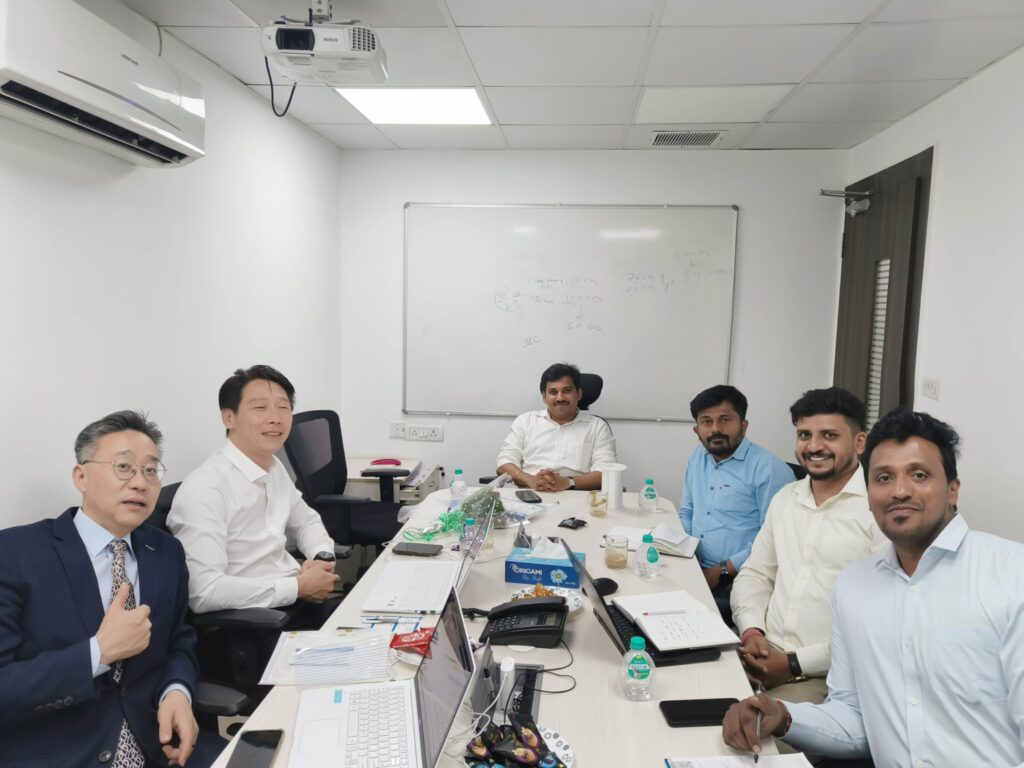
Figure 1: Inside Universal Sutures' ISO Class 7 cleanroom manufacturing facility in Bengaluru, India.
Uncompromised Quality Management & Ethics
Our operational management enforces continuous zero-defect policies. From raw material inspection (spectrophotometry, tensile testing) to micro-needle inspection under optical magnifiers, every step is fully traceable via batch numbers printed on all packaging levels.
Furthermore, Universal Sutures operates under strict social compliance frameworks—prohibiting child labor, supporting gender equality in industrial engineering, and providing continuous professional advancement programs for our workforce.
Ready to Elevate Your Surgical Suture Line?
Download our comprehensive product catalog, request sterile product samples, or consult with our OEM private label specialists today. Discover why leading hospitals and medical distributors in over 50 countries trust Universal Sutures.