Precision-manufactured absorbable hemostatic agents, specialized polymer meshes, and high-tensile wound closure devices engineered for optimal tissue management.
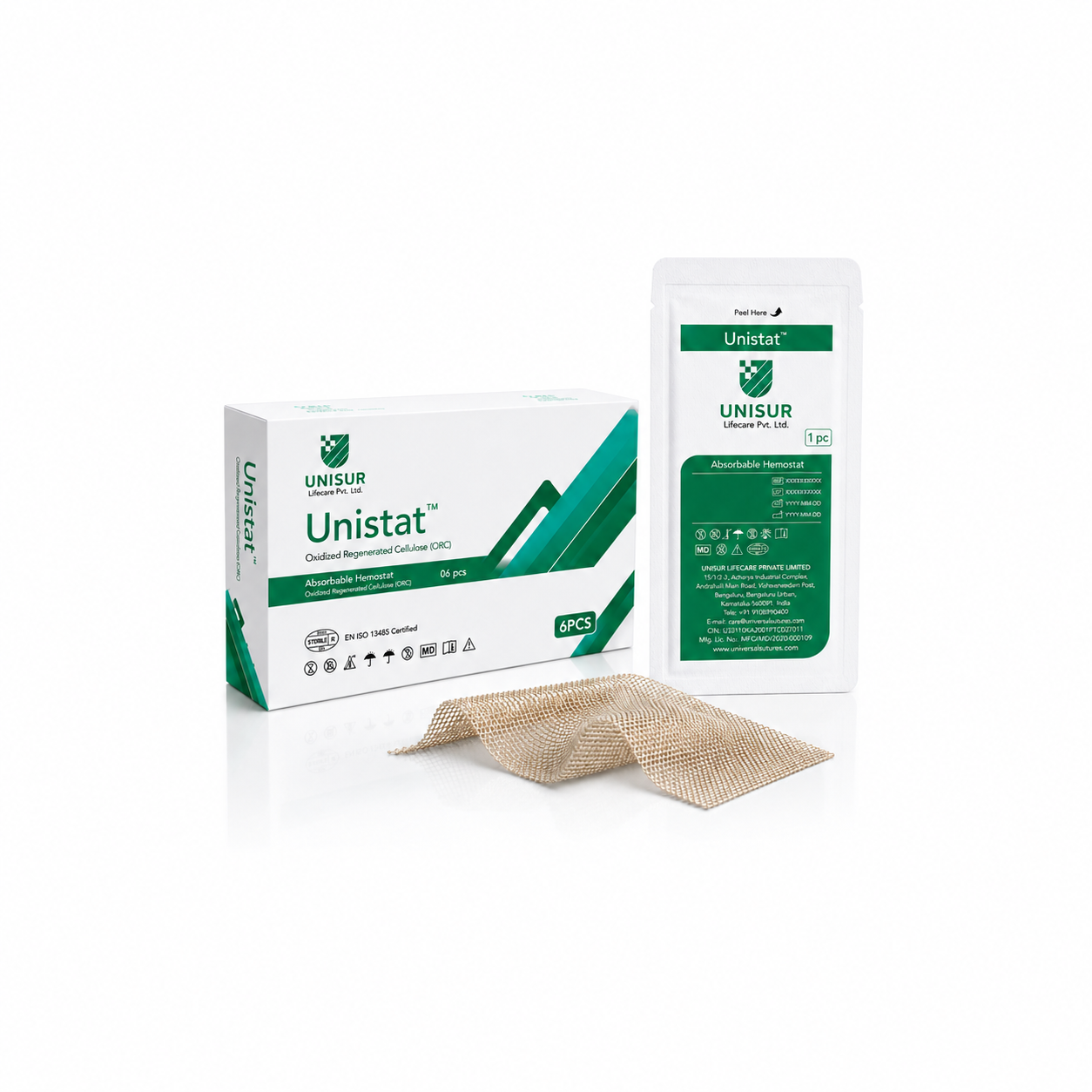
Oxidized Regenerated Cellulose (ORC) represents a cornerstone advancement in bioresorbable intra-operative hemostatic technology. Derived from highly purified plant-based alpha-cellulose through controlled oxidation, ORC features a uniform chemical composition rich in carboxylic acid moieties. Unlike non-regenerated oxidized cotton cellulose, regenerated cellulose undergoes dissolution and re-precipitation into ultra-pure rayon fibers before oxidation. This fundamental manufacturing distinction guarantees structural uniformity, consistent carboxyl density, and predictable bio-absorption kinetics without elicit minimal foreign-body tissue reaction.
When applied to oozing capillary, venous, or small arterial bleeding sites, UNISTAT™ Oxidized Regenerated Cellulose initiates hemostasis via a dual mechanical and biochemical pathway. Upon contact with blood, the low-pH matrix rapidly absorbs serum fluid, expanding into a dark brown or black gelatinous plug. This physical mass acts as a structural scaffold that stabilizes clot formation at the vascular boundary. Simultaneously, the low ambient pH (carboxylic acid content between 16% and 22%) accelerates the denaturation of blood proteins—specifically hemoglobin—forming acid hematin, which rapidly seals damaged capillary beds.
Information Gain Insight: The localized low pH environment produced by UNISTAT™ ORC exhibits documented broad-spectrum antimicrobial activity in vitro against both Gram-positive and Gram-negative organisms, including methicillin-resistant Staphylococcus aureus (MRSA), vancomycin-resistant Enterococcus (VRE), and Pseudomonas aeruginosa. This intrinsic bactericidal effect provides an indispensable secondary protective barrier against surgical site infections (SSIs) during complex procedures.
The degradation of UNISTAT™ ORC occurs predominantly through non-enzymatic hydrolytic cleavage of glycosidic bonds, supplemented by macrophage-mediated phagocytosis. Within 7 to 14 days of implantation, the material breaks down completely into soluble oligosaccharides, glucuronic acid, and glucose units. Histological studies demonstrate complete tissue clearance within 14 to 28 days without fibrous encapsulation or calcification. Because the raw material source is 100% plant-derived, UNISTAT™ eliminates all residual risks of Transmissible Spongiform Encephalopathies (TSE) or Bovine Spongiform Encephalopathy (BSE) associated with animal-derived collagen or thrombin hemostats.
Zero risk of animal-borne pathogens (BSE/TSE free). 100% biocompatible alpha-cellulose substrate.
Accelerates blood clot formation within 120–180 seconds across capillary and parenchymal tissue bleedings.
Acidic micro-environment inhibits bacterial proliferation of antibiotic-resistant strains (MRSA, VRE) at surgical sites.
Sydney stands as Australia’s largest healthcare hub, encompassing leading public hospital networks within the South Eastern Sydney Local Health District (SESLHD), Sydney Local Health District (SLHD), and Northern Sydney Local Health District (NSLHD), alongside premier private hospital operating groups like Ramsay Health Care and Healthscope. Medical facilities across the Greater Sydney region—from Royal Prince Alfred Hospital (RPA) and St Vincent's Hospital in Darlinghurst to Westmead Hospital—demand clinical-grade surgical consumables that deliver absolute consistency, compliance, and procedural efficiency.
In open-heart surgical procedures, such as Coronary Artery Bypass Grafting (CABG) or aortic valve replacements, diffuse suture line oozing and bleeding from vascular anastomosis sites present high risks under systemic heparinization. UNISTAT™ KNIT Heavy-Duty ORC provides the structural density required to wrap around prosthetic grafts or hold firmly against high-pressure arterial suture lines. Surgical teams in Sydney rely on its high burst resistance and rapid absorption profile, ensuring that retrosternal hematomas are avoided prior to chest closure.
In craniotomy and complex spinal fusion procedures, controlling venous bleeding from the epidural space, dura mater, or cancellous bone edges requires a flexible, conformable hemostatic agent. UNISTAT™ Fibrillar layered ORC can be easily tufted, peeled into micro-layers, or shaped into cottonoid-like pledgets. It conforms perfectly to delicate neural structures without causing mechanical compression on spinal nerve roots or brain tissue. Its complete absorption within 7 to 14 days eliminates the complication of residual mass effect during post-operative MRI or CT follow-up scans.
With Sydney’s rapid migration toward Minimally Invasive Surgery (MIS) and Robotic-Assisted Laparoscopic Prostatectomy (RALP), surgical instruments are deployed through 5mm or 10mm trocar channels. UNISTAT™ Standard ORC possesses ideal mechanical memory and flexibility, allowing surgical nurses to roll the material into tight cylinders for smooth trocar insertion. Once deployed intra-abdominally, UNISTAT™ uncurls cleanly and adheres smoothly to resection margins during laparoscopic partial nephrectomy, cholecystectomy, or gynaecological myomectomy.
The Australian medical device regulatory regime, administered by the Therapeutic Goods Administration (TGA), categorizes absorbable intra-operative hemostats as Class III medical devices due to their systemic bio-absorption and direct contact with central circulatory and nervous systems. Overseas manufacturers exporting to Sydney must provide comprehensive Technical Documentation, ISO 13485 certification, and clinical evaluation reports aligned with the EU MDR (Regulation 2017/745) framework to secure Australian Register of Therapeutic Goods (ARTG) inclusion.
In response to severe supply chain bottlenecks and escalating costs associated with dominant Western brand monopolies, hospital procurement directors across New South Wales (NSW Health) and private day surgery networks are actively seeking reliable direct-from-manufacturer OEM/ODM partnerships in China. China’s advanced bio-polymer manufacturing sector now offers equivalent or superior clinical efficacy at significantly optimized unit economics, enabling Sydney hospital groups to achieve up to 35% cost reductions in their surgical consumables budgets without compromising patient safety.
| Performance Parameter | UNISTAT™ ORC (Plant Cellulose) | Gelatin Sponges (Porcine/Bovine) | Microfibrillar Collagen | Thrombin Matrix Sealants |
|---|---|---|---|---|
| Raw Material Origin | 100% Purified Plant Cellulose | Porcine / Bovine Skin Gelatin | Bovine Corium Collagen | Human/Bovine Plasma Thrombin |
| BSE/TSE Infection Risk | Zero (100% Synthetic/Plant) | Moderate (Requires Clearance) | Moderate to High | Potential Viral/Prion Risk |
| Hemostasis Speed | 2 to 3 Minutes | 5 to 8 Minutes | 3 to 5 Minutes | 1 to 2 Minutes |
| In Vivo Absorption Time | 7 to 14 Days | 4 to 6 Weeks | 8 to 12 Weeks | Variable (Slow Resorption) |
| Intrinsic Antibacterial Property | Yes (Low pH Bactericidal) | No | No | No |
| Storage & Handling | Room Temp (15°C–30°C) | Room Temp | Room Temp | Requires Cold Chain / Reconstitution |
As a premier Chinese manufacturer and global exporter serving the Sydney market, our production facilities are constructed to exceed global healthcare standards. Operating under strict ISO 13485:2016 quality systems, our cleanrooms are certified to Class 10,000 (ISO Class 7) for chemical synthesis and Class 100,000 (ISO Class 8) for primary packaging and needling assemblies. Every batch of UNISTAT™ Oxidized Regenerated Cellulose undergoes rigorous analytical testing for carboxyl content verification, residual solvent analysis via gas chromatography, moisture determination, and bio-burden testing prior to terminal Ethylene Oxide (EO) sterilization.
Exceeding Pharmacopoeial Standards: Our internal Quality Control (QC) protocols enforce a minimum threshold of 1.1× USP requirements for physical tensile strength, suture retention, and pull-out force. This ensures that UNISTAT™ hemostats and accompanying wound closure products withstand aggressive intra-operative handling during high-stress procedures.
Our integrated R&D team provides full OEM and Private Label manufacturing capabilities tailored for Australian medical distributors. We offer customized packaging designs, multi-language artwork compliant with TGA labeling regulations, customizable sheet dimensions (e.g., 2"x4", 4"x4", 0.5"x2"), and full dossier support (STED format) for seamless ARTG registration in Australia.
Elevate your surgical product portfolio with high-margin, TGA/CE-ready Oxidized Regenerated Cellulose hemostatic matrices designed for Sydney’s leading hospitals and surgical centers.