Precision-engineered medical devices for French hospitals, surgical centers, and healthcare procurement groups (UniHA, RESAH, UGAP).
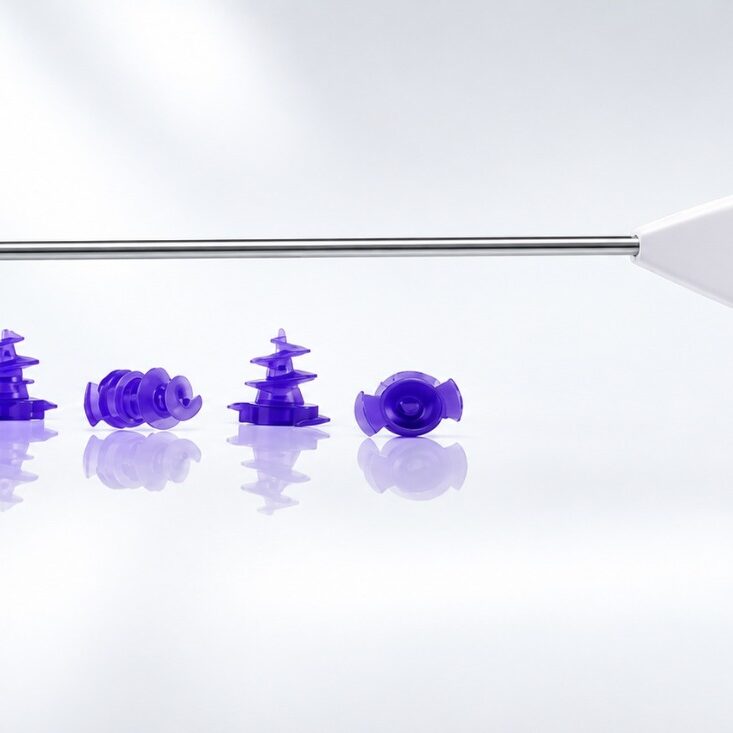
Minimally invasive abdominal wall surgery in France has undergone a fundamental transformation over the past decade. Surgical departments across public hospital networks (such as Assistance Publique – Hôpitaux de Paris (AP-HP), CHU de Lyon, CHU de Bordeaux) and private clinic conglomerates (including Elsan and Ramsay Santé) have overwhelmingly adopted laparoscopic transabdominal preperitoneal (TAPP) and total extraperitoneal (TEP) repair as standard care for inguinal and ventral hernioplasties.
Central to this evolution is the clinical imperative to minimize postoperative chronic groin pain (inguinodynia) and eliminate long-term foreign body sensation. Traditional titanium mesh tacks—while offering robust initial mechanical anchoring—remain permanently in the patient's anatomical tissue. Over time, permanent metallic fasteners can lead to nerve entrapment (specifically nerve irritation of the ilioinguinal or genitofemoral nerves), tissue fibrosis, erosion, and persistent patient discomfort requiring surgical revision.
As a leading absorbable mesh tacker manufacturer and exporter servicing France, Unisur Lifecare (Universal Sutures) delivers next-generation fixation systems engineered from synthetic bioresorbable polymers. Our UNITACK™ Absorbable Mesh Fastener provides powerful immediate holding strength to secure synthetic meshes (such as lightweight monofilament polypropylene) during the critical early wound healing phase (4 to 12 weeks), before undergoing complete, predictable hydrolysis into harmless endogenous metabolites (lactic acid and glycolic acid).
The performance of an absorbable mechanical fastener depends heavily on copolymer formulation, needle/thread geometry, shaft flexibility, and ergonomic torque transmission. The UNITACK™ system incorporates high-precision medical-grade Poly(L-lactide-co-glycolide) (PLGA copolymer ratio 82:18 / 85:15), carefully optimized to balance bio-degradation rates with mechanical pull-out force resistance.
Retains over 80% of structural shear strength at 3 weeks post-implantation, maintaining mesh apposition throughout collagen matrix deposition. Full mass absorption occurs predictably between 12 to 18 months via the citric acid cycle with zero toxic tissue residue.
The hollow helical screw configuration penetrates both macroporous and microporous synthetic meshes smoothly, locking firmly into Cooper’s ligament, posterior rectus sheath, or abdominal wall fascia with an average pull-out resistance exceeding 35 Newtons.
Features a 35cm 5mm rigid shaft compatible with standard laparoscopic trocars. Tactile indicator wheels allow surgeons in France to deploy 12 or 30 pre-loaded tacks seamlessly with smooth 360° rotational control.
Surgical procurement teams in France evaluate medical devices based on clinical evidence, complication risk profiles, and total cost of care. Below is an analytical comparison of common hernia mesh fixation methods utilized across European surgical centers:
| Fixation Modality | Material Composition | Initial Holding Strength | Resorption Timeframe | Risk of Chronic Neuralgia | EU MDR Compliance Status |
|---|---|---|---|---|---|
| UNITACK™ Absorbable Tacker | Synthetic PLGA Copolymer (82:18) | Very High (>35 N) | 12–18 Months (Complete Hydrolysis) | Extremely Low | CE Mark Class III (Regulation 2017/745) |
| Permanent Titanium Tacks | Grade 5 Titanium Alloy | High (>30 N) | Non-Absorbable (Permanent) | Moderate to High (Nerve Entrapment) | Legacy CE / EU MDR Transitions |
| Permanent Stainless Steel Tacks | 316L Surgical Steel | High (>32 N) | Non-Absorbable (Permanent) | High (Tissue Fibrosis Risk) | Legacy CE Certification |
| Biological Fibrin Glue / Sealants | Human/Bovine Plasma Proteins | Moderate (10–15 N) | 2–4 Weeks (Rapid Enzymatic) | Extremely Low | Biologics Annex Requirements |
| Cyanoacrylate Synthetic Adhesives | n-Butyl / Octyl Cyanoacrylate | Moderate (>18 N) | Slow Degradation (Variable) | Low (Exothermic Thermal Risk) | Medical Device Class IIb/III |
Healthcare facilities across regions like Île-de-France, Auvergne-Rhône-Alpes, and Provence-Alpes-Côte d'Azur require high-performing fixation systems that seamlessly integrate into established surgical protocols. The UNITACK™ system is manufactured to strictly align with the clinical workflows of French visceral and digestive surgeons (Chirurgie Viscérale et Digestive):
In Transabdominal Preperitoneal (TAPP) and Totally Extraperitoneal (TEP) procedures, surgeons utilize UNITACK™ to secure lightweight monofilament polypropylene mesh onto Cooper's ligament and the anterior abdominal wall superior to the inferior epigastric vessels—safely avoiding the "Triangle of Pain" and "Triangle of Doom".
For laparoscopic Intraperitoneal Onlay Mesh (IPOM+) procedures, absorbable tacks provide essential double-crown perimeter fixation. The high shear strength prevents mesh migration or sagging under intra-abdominal pressure spikes during coughing or physical exertion.
With the rapid expansion of robotic surgical platforms (Intuitive da Vinci, Hugo™ RAS) across French university hospital centers (CHU), the ergonomic 360° rotating delivery tip allows robotic bedside assistants to execute fast, reliable tack placement without disrupting wrist-articulated instrument movements.
The regulatory framework governing medical device importation into France has become significantly more rigorous under the European Union’s Medical Device Regulation (EU MDR 2017/745). The French National Agency for Medicines and Health Products Safety (ANSM - Agence Nationale de Sécurité du Médicament et des Produits de Santé) and the French National Authority for Health (HAS - Haute Autorité de Santé) demand uncompromised clinical evaluation data, post-market clinical follow-up (PMCF), and comprehensive technical dossiers for Class III implants.
Key market drivers currently shaping French medical device purchasing include:
Universal Sutures (Unisur Lifecare Pvt. Ltd.) operates as an established global manufacturer and exporter of surgical wound closure devices. As the second medical device manufacturer in India to secure prestigious EU MDR (Regulation 2017/745) certification across 13 distinct product families, our facility in Bengaluru delivers world-class medical manufacturing to European buyers.
Every batch of sutures, hernia mesh, and mesh tackers undergoes stringent quality control testing, achieving tensile strength and needle-attachment pull resistance at minimum 1.1 times USP requirements, providing surgeons in France with an added margin of intra-operative safety.
Our 200+ dedicated manufacturing team operates within validated ISO Class 7 cleanrooms. Fully automated braiding, needling, foil-sealing, and ethylene oxide (EO) sterilization cycles ensure batch-to-batch sterility assurance levels (SAL 10⁻⁶).
Over 70% of our production workforce comprises trained female technicians and engineers. We strictly enforce ethical manufacturing, zero child labor, and continuous technical skill-building aligned with international ESG standards.
Yes. Universal Sutures holds certified EU MDR (Regulation 2017/745) and ISO 13485:2016 quality system approvals issued by accredited European Notified Bodies. Complete Technical Dossiers, Certificates of Free Sale (CFS), Declarations of Conformity, and Clinical Evaluation Reports (CER) are fully available for French market registration and hospital tender submissions.
UNITACK™ is supplied as a single-use sterile device pre-loaded with either 12 fasteners (ideal for unilateral inguinal TAPP/TEP repair) or 30 fasteners (engineered for complex bilateral hernia repair or large ventral IPOM+ mesh fixation).
Clinical studies demonstrate that bioresorbable PLGA fasteners significantly reduce post-operative inguinodynia. Because the tacks resorb completely within 12 to 18 months after mesh integration into surrounding fascial tissue, there are no permanent foreign bodies left behind to cause nerve compression or chronic tissue inflammation.
Absolutely. Universal Sutures provides end-to-end OEM and private-label manufacturing. We support French distributors with custom box artwork, French language IFUs (Instructions for Use), specialized pack formats, barcode registration (UDI-DI / EUDAMED integration), and regulatory dossier backing.
Our absorbable mesh tackers have a validated shelf life of up to 3 years when stored in their original moisture-barrier double packaging under standard room temperature conditions (below 25°C, away from direct thermal radiation).
We routinely export directly to major French logistic gateways including Paris Charles de Gaulle (CDG), Port of Le Havre, and Marseille-Fos. We handle complete export customs documentation, Certificate of Origin, batch Certificates of Analysis (CoA), and temperature-controlled freight forwarding.
Yes. We supply evaluation samples and non-sterile demo units to qualified medical device distributors and hospital procurement committees in France upon verification of commercial license credentials.
Expand your surgical portfolio in France with CE MDR certified mesh tackers, polypropylene hernia meshes, ORC haemostats, and premium surgical sutures. Request OEM terms or distributor pricing today.
Send an Inquiry