
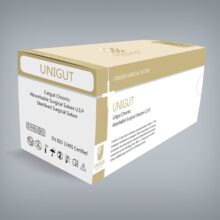
Custom OEM Chromic Catgut Suture
- Purified Submucosa Collagen
- Chromium Trioxide Tanned
- Absorption: 60-90 Days
- 1.1x USP Tensile Margin
Explore our export-ready surgical sutures, absorbable biopolymers, and industrial polymer netting engineered to international USP/EP standards.
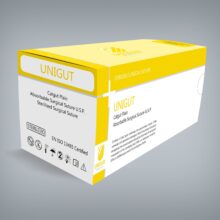
In modern surgical reconstruction, Chromic Catgut remains a pivotal absorbable biological strand due to its exceptional knot pliability, high initial tensile holding power, and predictable enzymatic degradation. Manufactured from purified collagen derived from the submucosa layer of bovine intestines, Chromic Catgut undergoes a meticulous cross-linking process with trivalent chromium salts (chromium trioxide bath). This chemical treatment delays enzymatic breakdown in host tissue compared to untreated Plain Catgut.
As a premier custom OEM Chromic Catgut manufacturer and exporter, our production architecture is rooted in strict biomedical engineering standards. Natural collagen strands are spun, calibrated to precise USP diameters, and treated under controlled pH and temperature conditions to achieve consistent cross-linking density. This ensures that the suture resists early digestion by lysosomal enzymes during the critical initial phases of tissue healing.
E-E-A-T Quality Commitment: Every batch of our OEM Chromic Catgut is validated to possess a minimum tensile strength and needle-attachment pull-off force equal to 1.1 times the United States Pharmacopeia (USP) minimum requirement, guaranteeing superior safety in surgical closures.
Understanding the kinetic breakdown of Chromic Catgut is paramount for hospital buyers and surgical teams. Unlike synthetic absorbable polymers (such as PGA or PGLA) which degrade via non-enzymatic hydrolytic cleavage, Chromic Catgut is absorbed through macrophage enzymatic digestion (phagocytosis). The chromium salt treatment regulates this enzymatic attack, maintaining functional wound support for 21 to 28 days, with complete tissue absorption typically finalized between 60 to 90 days depending on tissue vascularity and patient metabolic factors.
| Suture Material | Raw Material Source | Degradation Mechanism | Tensile Retention Period | Complete Absorption | Primary Surgical Applications |
|---|---|---|---|---|---|
| Chromic Catgut | Bovine Serosa / Submucosa | Enzymatic Phagocytosis | 21 – 28 Days | 60 – 90 Days | OB/GYN, General Closure, Urology, GI Tech |
| Plain Catgut | Bovine Intestinal Submucosa | Rapid Enzymatic Digestion | 7 – 10 Days | 70 Days | Mucosal Repair, Ophthalmic, Subcutaneous |
| PGA (Polyglycolic Acid) | Synthetic Polymer (Braided) | Hydrolytic Cleavage | 28 – 30 Days | 60 – 90 Days | Soft Tissue Approximation, Orthopedics |
| PDS (Polydioxanone) | Synthetic Polymer (Monofilament) | Slow Hydrolysis | 40 – 60 Days | 180 – 210 Days | Abdominal Wall Closure, Pediatric Cardio |
Analyzing shifting buyer behaviors, regulatory hurdles, and OEM private-label manufacturing models in the surgical devices sector.
Global hospital networks and medical device distributors are aggressively phasing out suppliers lacking EU MDR certification. Securing compliant technical documentation is now non-negotiable for market access.
Procurement directors are reducing supplier bloat by partnering with contract manufacturers capable of fulfilling both surgical suture lines and complementary medical polymer meshes under a single ISO 13485 QMS framework.
Ethical raw material sourcing has become critical. OEM buyers demand 100% BSE/TSE-free certificates of origin, validating that bovine tissue stems from closed-herds in certified disease-free regions.
In response to volatile supply chains and expanding surgical demands in emerging markets, hospital groups and international medical brands are increasingly transitioning from off-the-shelf distributor procurement to custom **OEM (Original Equipment Manufacturer) private-label programs**. Partnering directly with an established manufacturer enables brand owners to specify exact needle geometries, custom thread lengths, tailored absorption windows, and localized multi-lingual secondary packaging.
Our OEM manufacturing lines empower international partners to establish their proprietary brand presence without incurring massive capital expenditure in cleanroom infrastructure, automated needle-swaging machinery, or complex ethylene oxide (EO) sterilization setups.
Powered by Unisur Lifecare — India’s pioneer in EU MDR certified surgical wound closure manufacturing.

Unisur Lifecare is proudly the second medical device manufacturer in India to secure full EU MDR (Regulation 2017/745) certification across 13 comprehensive product families.
Our state-of-the-art facility in Bengaluru operates ISO Class 8 cleanrooms for spinning, braiding, micro-needling, foil packaging, and automated EO gas sterilization.
We foster an inclusive manufacturing ecosystem where over 70% of our production team members are skilled women, driving operational precision and workplace equality.
Detailed answers to key technical, regulatory, and logistics queries from global surgical supply buyers.
We provide full turn-key OEM services, including custom foil print designs, localized language box artwork, private brand logo integration, varied suture lengths (from 45cm to 150cm), and tailored needle selections (taper point, cutting, reverse cutting, micro-ribbed 300 series stainless steel).
All surgical sutures manufactured at our facility adhere strictly to USP and EP standards. Furthermore, our internal QC protocols enforce a 1.1× USP tensile strength safety threshold on both thread break-strength and needle-to-suture attachment pull force.
Sutures are hermetically sealed in primary aluminum foil packs within an ISO Class 8 cleanroom. Sterilization is executed using validated Ethylene Oxide (EO) gas cycles in accordance with ISO 11135, accompanied by full biological indicator verification and sterility batch certificates.
Yes. Our raw bovine tissue is strictly sourced from certified BSE/TSE-free geographic regions. Every shipment includes comprehensive veterinary health clearance certificates and compliance documentation for global customs clearance.
MOQs depend on specific customization needs (e.g., custom foil printing vs. standard neutral foil with custom outer boxes). Standard private-label runs generally start at 500 dozen per code, but flexible pilot options are available for market registration trials.
Absolutley. We equip our OEM clients with comprehensive regulatory dossier support, including technical files, stability test data, biocompatibility reports (ISO 10993), clinical evaluation reports (CER), and CE / EU MDR certificate copies for seamless national health authority approval.