Explore Products View Certificates
0%

What Is Monofilament Polyamide Suture? The answer begins with its structure. Monofilament Polyamide Sutures use one continuous polymer strand. They are commonly known as nylon sutures. Their smooth surface can reduce tissue drag during placement and removal. This feature matters in delicate skin closure, plastic surgery, and selected soft-tissue procedures. The strand is usually nonabsorbable, although its tensile strength gradually decreases inside the body.

Industry reports show why this material remains relevant. Grand View Research and Fortune Business Insights identify surgical sutures as a steadily expanding medical-device segment. Their analyses link growth to rising surgical volumes, aging populations, and improved wound-care practices. However, market growth does not prove clinical superiority. A popular product can still be unsuitable for a specific wound. That point is easy to overlook.

The U.S. Food and Drug Administration treats surgical sutures as regulated medical devices. Manufacturers must support safety, performance, labeling, and quality controls. Relevant evaluations may also consider biocompatibility principles described in ISO 10993. In practice, clinicians examine needle design, knot security, tensile strength, tissue response, and infection risk. Handling experience matters too. Nylon can feel smooth between gloved fingers, yet its memory may make knot management less forgiving. More throws may be needed, depending on the product and technique.

This article explains the material, benefits, limitations, and common applications of Monofilament Polyamide Sutures. It also separates laboratory specifications from real operating-room decisions. No suture is perfect. Selection should follow wound characteristics, surgical judgment, manufacturer instructions, and applicable clinical standards.
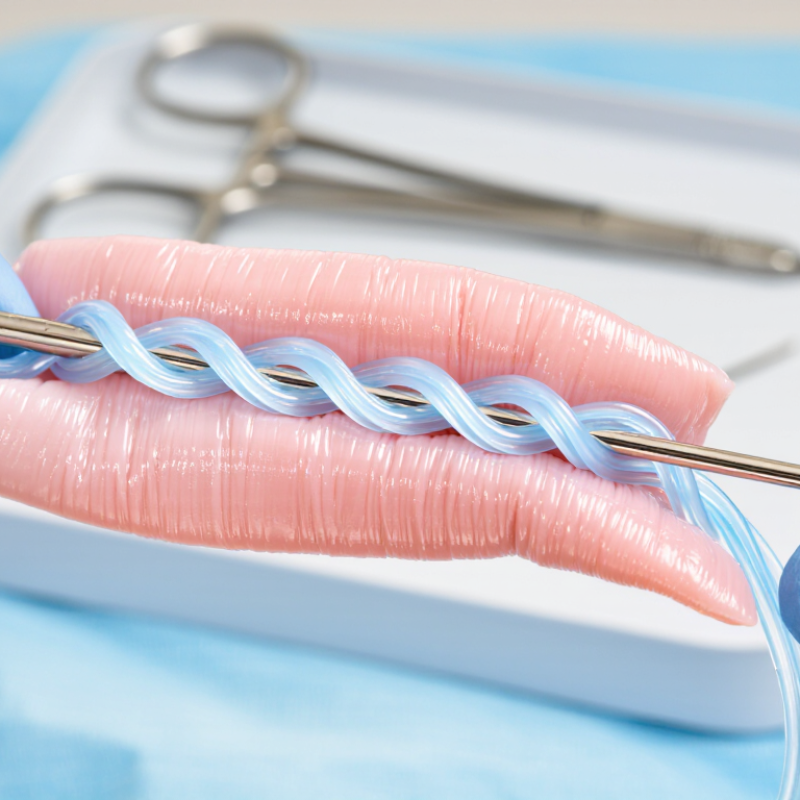
What Is Monofilament Polyamide Suture?

Definition and Core Composition of Monofilament Polyamide Suture

Monofilament polyamide suture is a sterile, synthetic thread made from one continuous filament. Unlike braided sutures, it has no woven strands or surface fibers. Its core material is polyamide, commonly formed from nylon-type polymers such as polyamide 6 or polyamide 6,6. These polymers contain repeating amide groups along a carbon-based molecular chain. This structure gives the suture useful tensile strength, flexibility, and a relatively smooth surface.

The smooth filament usually passes through tissue with limited drag. It also provides fewer spaces for fluid and microorganisms to collect than braided material. For this reason, clinicians may consider it when reducing surface contamination is important. Polyamide is generally classified as nonabsorbable, although its strength can gradually change inside the body. Water absorption, tissue conditions, diameter, and implantation time all influence performance. The thread is usually supplied in measured sizes, with a needle attached or selected separately.

Handling reveals both strengths and weaknesses. It tends to resist tissue sawing, but its memory can make it spring back from a curved shape. Knot security deserves careful attention. More throws may be needed, depending on the size and surgical technique. The material is not flawless. Its stiffness may irritate delicate tissue, while long-term strength retention is not identical in every clinical setting. Selection should match wound tension, tissue type, healing time, and applicable medical standards. Even experienced users should review the product’s verified specifications before use.

What Is Monofilament Polyamide Suture?

Elemental composition of the repeating units used in common polyamide materials for monofilament sutures

Monofilament polyamide suture is a single-strand surgical thread made from a synthetic nylon polymer. The chart compares the atoms in one repeating unit of Nylon 6 (C6H11NO) and Nylon 6,6 (C12H22N2O2). Both structures contain carbon, hydrogen, nitrogen, and oxygen, with amide groups forming the polymer backbone. A single continuous filament provides a smooth surface and avoids the interstices found in braided suture constructions.

Key Material Properties and Structural Characteristics

Monofilament polyamide suture is a nonabsorbable thread formed from one continuous nylon filament. Its single-strand structure creates a smooth, relatively low-friction surface. That design can reduce tissue drag during passage. It also leaves fewer spaces for fluid or microorganisms than braided construction. However, “nonabsorbable” does not mean mechanically unchanged forever. Polyamide may gradually lose strength inside the body, depending on time, tissue conditions, and suture diameter. This distinction matters during material selection.

Its key structural feature is uniformity. The filament has no interlaced fibers, so its diameter is generally consistent along the working length. It bends easily, but it may show memory after packaging. In practical handling, the thread can spring toward its original coil. Careful tension and deliberate knot placement help control it. Knot security depends on surface friction, loop configuration, and the number of throws. A very smooth filament can pass cleanly through tissue, yet it may demand more attention at the knot. Small differences in handling can matter.

Polyamide offers useful tensile strength, flexibility, and relatively low tissue reactivity. It may suit situations requiring prolonged support without permanent implant behavior. Still, performance changes with size, needle attachment, sterilization, and storage conditions. The thinnest option is not automatically the gentlest, and the strongest option is not always easiest to handle. Not always. Selection should match tissue movement, healing time, and the operator’s technique. Testing standards and device instructions remain essential references.

Medical Applications and Common Suture Uses

What Is Monofilament Polyamide Suture?

Medical Applications and Common Suture Uses

Monofilament polyamide suture is a single-strand, nonabsorbable material commonly used for wound closure. Its smooth surface passes through tissue with relatively low drag. This may reduce tissue disruption during placement. It also resists fluid absorption, which can help limit bacterial wicking along the suture path. Clinicians often choose it for skin closure, especially when a clean cosmetic result matters. It may also support soft-tissue approximation, ophthalmic procedures, and selected plastic surgery repairs.

It has limitations. Polyamide can have noticeable memory, making it curl after removal from its package. Knot security may require careful technique and an appropriate number of throws. For this reason, handling experience matters. It is often used where long-term tensile support is unnecessary, because the suture remains in the body unless removed. Common examples include facial lacerations, small skin incisions, and areas requiring precise edge alignment. It may be less suitable for wounds under constant tension or tissues needing prolonged reinforcement. No material fits every wound. In practice, wound location, tissue strength, contamination risk, and healing time should guide selection. I used to view smooth passage as the main advantage, but dependable closure also depends on tension control and follow-up care. More thought is needed there.

Advantages and Limitations in Clinical Practice

What Is Monofilament Polyamide Suture?

Advantages and Limitations in Clinical Practice

Monofilament polyamide suture uses a single smooth strand of synthetic material. Its surface usually passes through tissue with limited drag. This can reduce sawing during skin closure. It may also leave fewer spaces where bacteria and fluid can collect than braided suture. Tissue reaction is generally mild. These features make it useful for selected skin, facial, and soft-tissue procedures.

Handling is less forgiving. The smooth strand can slip, so secure knot technique matters. More throws may be needed, depending on the suture size and tissue tension. It also has memory, which can make the strand spring away from the wound. A clinician may see this clearly when working through a small incision. Careful tension is essential. Excessive tightness can mark the skin or restrict local circulation.

Polyamide is usually considered nonabsorbable, but its strength can decrease gradually in living tissue. It may therefore require planned removal when used for external closure. Timing depends on location, healing, tension, and patient factors. It is not automatically the best choice for every wound. A clean-looking material can still cause irritation, knot problems, or poor cosmetic results. Clinical judgment, tissue handling, and follow-up remain more important than the material alone. Evidence supports its practical value, but individual outcomes can vary.

What Is Monofilament Polyamide Suture? - Advantages and Limitations in Clinical Practice

Clinical Dimension Evidence-Based Description Clinical Advantages Limitations or Precautions
Material and Structure A synthetic, single-filament suture made from polyamide, commonly referred to as nylon. The smooth surface allows the strand to pass through tissue with relatively low drag and reduces sites where microorganisms can lodge. The smooth, relatively stiff filament may be more difficult to handle than braided sutures.
Absorption Profile Classified as nonabsorbable. It is intended to remain in the body for prolonged support, although polyamide can gradually lose tensile strength over time. Provides long-term wound approximation when extended mechanical support is required. It may require later removal when used in accessible skin wounds, and it is not ideal when a fully absorbable material is preferred.
Tissue Reaction Usually produces a relatively low inflammatory response compared with many natural suture materials. Useful where minimizing foreign-body reaction is clinically important. Low reactivity does not eliminate the risks of infection, stitch abscess, granuloma, or extrusion.
Capillarity and Fluid Wicking A monofilament has no interstices between braided fibers, so it has minimal capillarity and limited fluid wicking. May reduce the pathway for fluid and bacteria compared with multifilament constructions. A monofilament is not inherently infection-proof; sterile technique, tissue handling, and wound care remain essential.
Handling and Knot Security The filament generally has more memory and spring-back than braided suture, and knot security depends strongly on knot configuration and the number of throws. Can provide smooth passage and a clean tissue profile when properly placed. May be harder to tie securely, particularly in a deep or wet field; appropriate knot technique and adequate tails are important.
Tensile Support Provides durable mechanical support and does not undergo rapid enzymatic absorption like absorbable sutures. Appropriate for tissues that heal slowly or require prolonged approximation. The suture does not replace sound surgical technique; excessive tension can cause tissue cutting, ischemia, or scarring.
Common Clinical Uses Commonly used for skin closure, selected soft-tissue approximation, microsurgical applications, and some ophthalmic or cardiovascular procedures, depending on the specific suture design and indication. Versatile for superficial closure and selected procedures requiring long-lasting support with low capillarity. The correct size, needle type, and removal plan must be selected for the tissue, wound tension, and healing rate.
Skin Closure Considerations Often selected when precise wound-edge approximation and prolonged support are desired. The smooth strand can support a neat interrupted or running closure when placed with appropriate tension. Visible sutures may cause track marks if left too long; removal timing should reflect anatomical site, wound tension, and patient factors.
Performance in Wet Conditions Polyamide can absorb a small amount of moisture, which may influence handling and strength characteristics. Still offers the practical benefits of a monofilament structure in moist tissue environments. Wet-field handling may feel less predictable, and knot security should be checked carefully.
Overall Clinical Balance A low-reactivity, nonabsorbable monofilament that combines long-term support with low capillarity. Useful when minimizing tissue drag, fluid wicking, and premature loss of support is a priority. Its principal trade-offs are greater memory, more demanding knot technique, possible need for removal, and potential late suture-related complications.

Clinical selection should be based on tissue type, wound tension, expected healing time, infection risk, anatomical location, and the instructions for the specific suture product.

Handling, Safety, and Selection Considerations

Monofilament polyamide suture is a single-strand, synthetic, nonabsorbable material. Its smooth surface usually produces less tissue drag and may reduce spaces where bacteria can lodge. Handling, however, is not effortless. The strand can show memory, curl after removal, and feel less forgiving during knot tying. Practice matters. A loose final knot can compromise an otherwise careful closure.

Safety begins before the needle enters tissue. Check package integrity, sterility indicators, expiration status, and the correct USP size. Use gentle needle handling and avoid crushing the filament with instruments. Excessive tension can cut fragile tissue, while insufficient tension may leave dead space.

The WHO Global Guidelines for the Prevention of Surgical Site Infection report that surgical-site infections affect about 11% of patients in low- and middle-income countries. This figure makes aseptic technique, wound assessment, and appropriate suture selection clinically important.

Selection should reflect tissue strength, healing time, contamination risk, and the surgeon’s technique. Polyamide may suit skin closure and situations requiring sustained support, but it is not automatically the best choice for every tissue. The 2017 CDC Guideline for the Prevention of Surgical Site Infection emphasizes safe operative technique and evidence-based wound care rather than one universal suture material. In practice, knot security deserves a realistic trial, not an assumption. I have found that a familiar suture can still behave unexpectedly when gloves, moisture, or tissue tension change. That small uncertainty deserves attention.

FAQS

What is monofilament polyamide suture?

It is a sterile, synthetic thread made from one continuous polyamide filament. It has no woven strands. The smooth surface usually passes through tissue with limited drag.

Is monofilament polyamide suture absorbable?

It is generally considered nonabsorbable. The body does not simply dissolve it after placement. Its strength may gradually change with water exposure, tissue conditions, and implantation time.

What are its common medical uses?

It is commonly used for skin closure, facial lacerations, and small surgical incisions. It may also support selected soft-tissue, ophthalmic, and cosmetic repairs. The wound must still be assessed carefully.

Why might clinicians choose this material?

Its smooth surface can reduce tissue drag during placement. It also has fewer surface spaces for fluid and microorganisms to collect. This may help when limiting surface contamination matters.

What handling problems should users expect?

The filament can remember its packaged shape and spring away from a curve. It may curl during placement. Gentle handling and controlled needle movement can improve accuracy.

Does it provide secure knots?

Knot security requires careful technique and suitable knot construction. Additional throws may be necessary, depending on diameter and surgical method. Technique matters.

When might this suture be less suitable?

It may be less suitable for wounds under constant tension. It may also be unsuitable when tissues need prolonged reinforcement. Stiffness can irritate delicate tissue in some cases.

What factors should guide suture selection?

Consider wound tension, tissue type, contamination risk, healing time, and closure location. The required removal time also matters. Smooth passage alone is not enough.

Does it always produce the best cosmetic result?

It can support precise skin-edge alignment and a clean appearance. However, cosmetic results also depend on tension control, placement, healing, and follow-up. I once underestimated those details. That judgment needs revision.

Conclusion

Monofilament Polyamide Sutures are single-strand surgical sutures made from a synthetic polyamide material. Their smooth, continuous structure creates relatively low surface friction, allowing the suture to pass through tissue with less drag and reducing the tendency to harbor microorganisms compared with some braided materials. They are generally nonabsorbable, offering dependable long-term support while maintaining useful strength and flexibility.

In clinical practice, Monofilament Polyamide Sutures are commonly selected for skin closure, soft-tissue approximation, and procedures where a neat wound appearance and minimal tissue reaction are important. Their advantages include good tensile strength, smooth handling through tissue, and reduced capillarity. However, their memory and limited knot-holding characteristics may require careful tension control and secure knot technique. Appropriate size selection, sterile handling, gentle placement, and regular assessment of the healing site are essential for safe use. The final choice should consider tissue type, healing requirements, surgical technique, and the patient’s individual condition.


Evelyn

Evelyn

Evelyn is a dedicated marketing professional with a deep understanding of our company’s products, services, and customer-focused approach. With extensive experience in market research, content strategy, and professional communication, Evelyn transforms complex product information into clear,......