Explore Products View Certificates
0%

Choosing reliable Non-Absorbable Surgical Sutures manufacturers in China requires more than comparing prices. Hospitals and distributors need evidence of material consistency, sterile packaging, needle performance, and production control. Common options include polypropylene, nylon, polyester, and stainless steel sutures. Each material behaves differently under tissue tension, moisture, and prolonged healing conditions.

Dr. David Leaper, a recognized authority on surgical-site infection prevention, has stated, “Every detail of surgical care can influence infection risk.” This principle applies directly to suture selection. A secure knot, smooth needle penetration, and intact packaging can affect the patient’s recovery. Small details matter.

This guide examines China’s leading Non-Absorbable Surgical Sutures manufacturers through a practical, evidence-focused lens. It considers product range, raw-material traceability, sterilization validation, quality certifications, and international supply experience. Factory audits also deserve attention. A polished website proves little. Buyers should request technical files, batch records, tensile-strength data, and samples for clinical evaluation.

Manufacturers may offer similar-looking sutures, yet performance can differ noticeably. One polypropylene strand may pass smoothly through delicate tissue, while another creates more drag. That difference is easy to overlook. It should not be.

The ranking is not absolute. Surgical requirements vary by specialty, country, and procurement policy. Some information may change as companies update facilities or certifications. Readers should verify current documentation before placing an order. Reliable sourcing takes patience, technical judgment, and occasional skepticism. That is the uncomfortable part.
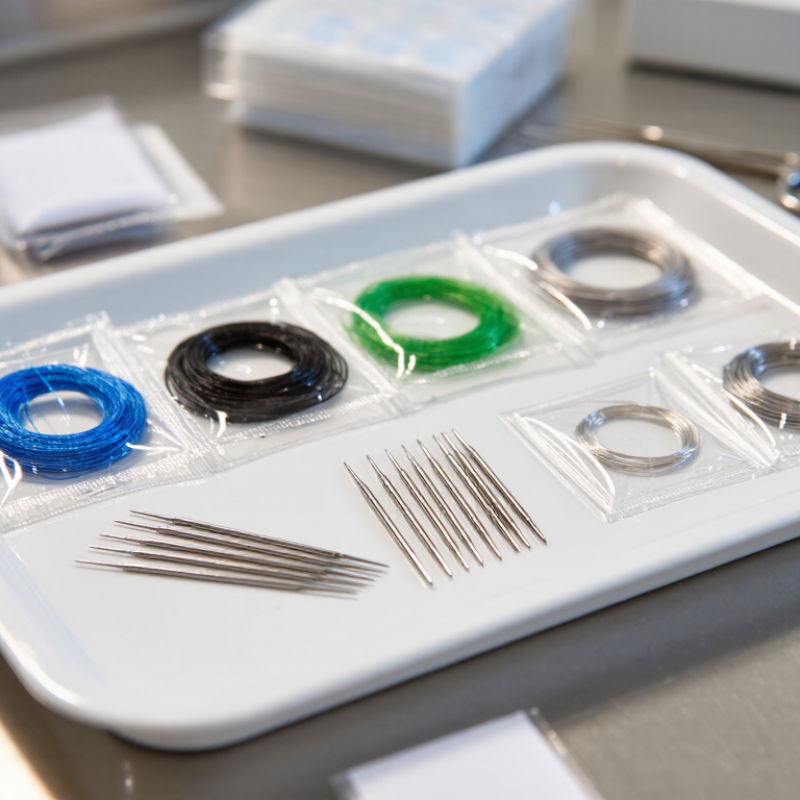
China Top Non Absorbable Surgical Sutures Manufacturers?

Non-Absorbable Surgical Sutures: Materials, USP Sizes, and Clinical Uses

Non-absorbable surgical sutures are selected when tissue support must remain for extended periods. Common materials include polypropylene, nylon, polyester, and stainless steel.

Polypropylene offers low tissue reactivity and useful handling in vascular closure.

Nylon is flexible and practical for skin repair, although it can lose strength gradually.

Polyester provides high tensile strength, yet its braided surface may increase fluid wicking.

Stainless steel is exceptionally strong, but handling requires control.

USP sizing expresses diameter, not guaranteed performance. Smaller sizes, such as 6-0 or 7-0, suit delicate facial or vascular work. Medium sizes, including 3-0 and 4-0, often support skin, tendon, or soft tissue closure. Larger sizes, such as 0 or 1, may be considered for high-tension areas. Exact choice depends on tissue thickness, tension, contamination risk, and surgical technique. Size alone is not enough.

Clinical use demands judgment. Monofilament sutures may reduce bacterial harboring, while braided sutures can offer easier knot security. That distinction matters in wounds exposed to moisture or movement.

Permanent sutures can support tendon repair, hernia reinforcement, cardiovascular closure, and selected skin procedures. They may also cause late irritation or become palpable.

In practice, the “best” suture is rarely universal. Product specifications, sterile packaging, needle geometry, and validated clinical protocols should be checked before use. Even experienced teams reassess their choices when healing, tension, or patient sensitivity differs from expectations.

China’s Suture Manufacturing Market: Output, Export Value, and Growth Data

China’s non-absorbable surgical suture sector has expanded with hospital demand, contract manufacturing, and export orders. Common products include nylon, polypropylene, polyester, silk, and stainless-steel sutures. Production is concentrated in coastal medical-device clusters, where factories combine extrusion, braiding, needle attachment, sterilization, and clean packaging.

2021–2024 Industry estimates suggest Chinese suture output grew by roughly 6% to 8% annually from 2021 to 2024. Export shipments also increased, supported by demand from Southeast Asia, the Middle East, Latin America, and parts of Europe. However, export value is difficult to measure precisely. Customs classifications often combine sutures with broader medical instruments. Available trade reviews place China’s annual suture-related export value in the hundreds of millions of US dollars, with moderate year-on-year growth rather than a sudden surge.

Quality evidence matters more than volume alone.
Experienced manufacturers usually provide material certificates, tensile-strength records, needle penetration tests, sterilization validation, and batch traceability. These details reveal production discipline. Some market reports appear optimistic, though. They may count packaging operations as full manufacturing or mix absorbable and non-absorbable products. Buyers should compare audited output, shipment records, defect rates, and regulatory documents before judging factory capability. The data is useful, but imperfect.

Top Chinese Manufacturers by ISO 13485, NMPA, and CE Certification

China Top Non Absorbable Surgical Sutures Manufacturers?

China’s non-absorbable suture sector is expanding with hospital demand and export growth. Grand View Research valued the global surgical sutures market at approximately USD 4.4 billion in 2023. It also projects continued growth through 2030. However, market size alone cannot confirm manufacturing quality.

A reliable Chinese manufacturer should provide a valid ISO 13485 certificate covering the actual production site. The certificate should match the suture category, sterilization process, and quality scope. For domestic sales, NMPA registration and product technical requirements are essential. For European distribution, CE marking must follow the applicable EU Medical Device Regulation pathway. Buyers should verify registration numbers, certificate validity, and authorized conformity assessment details. Non-absorbable materials require close review. Check tensile strength, needle attachment, coating uniformity, biocompatibility, and package integrity. Small differences become visible under surgical lighting.

Tips: Request three recent batch records. Compare knot security and needle penetration. Ask for sterilization validation, shelf-life data, and complaint records. Do not rely on a certificate PDF alone.

In practical supplier audits, traceability often deserves more attention than factory appearance. A clean showroom proves little. Lot coding should connect raw material records with final inspection results. Some suppliers communicate quickly but provide incomplete technical files. That is a warning, not a minor inconvenience. Buyers should also confirm whether testing uses recognized standards, such as applicable sections of ISO 10993 and ISO 7864. Certification supports trust, but consistent evidence builds it.

China Top Non Absorbable Surgical Sutures Manufacturers? - Top Chinese Manufacturers by ISO 13485, NMPA, and CE Certification

Evaluation Dimension ISO 13485 Evidence NMPA Evidence CE / EU Evidence Recommended Verification Point
Quality Management System A current ISO 13485 certificate covering the relevant manufacturing site and medical-device scope. A quality system capable of supporting applicable Chinese medical-device registration and production requirements. A documented quality system supporting EU conformity assessment under the applicable regulatory framework. Check certificate validity, site address, product scope, and certification body.
China Market Registration Document-controlled procedures for design, production, inspection, and post-market activities. Valid NMPA registration or filing, as applicable to the product classification and intended use. Not a substitute for Chinese market authorization. Confirm the registration or filing information against the official NMPA database where applicable.
EU Market Access Risk-management, validation, supplier-control, and corrective-action records maintained within the QMS. NMPA approval does not independently authorize sales in the European Union. CE marking supported by the applicable EU conformity-assessment route, technical documentation, and post-market obligations. Verify the EU declaration, technical documentation status, and notified-body involvement when required.
Suture Material Control Approved supplier lists, incoming inspection, material specifications, and lot traceability. Material information and product specifications consistent with the registered or filed product. Material safety and biological evaluation documented for the intended clinical use. Request raw-material specifications, certificates of analysis, and change-control records.
Sterilization Validation Validated sterilization processes, routine monitoring, equipment qualification, and requalification records. Sterility information and validation data aligned with the applicable Chinese registration requirements. Sterile-device conformity evidence, packaging validation, and applicable biological-safety documentation. Confirm sterilization method, validation standard, residual limits where relevant, and release criteria.
Packaging Integrity Validated sealing, packaging-process controls, inspection records, and nonconformity procedures. Packaging specifications and labeling consistent with the approved or filed product information. Packaging performance and sterile-barrier evidence supporting the claimed shelf life. Review seal-strength testing, package-integrity testing, transport simulation, and aging studies.
Product Performance Inspection and test procedures for needle attachment, tensile strength, dimensions, and visual defects. Performance specifications and test reports supporting the Chinese product registration or filing. Technical and clinical evidence appropriate to the intended purpose and applicable EU requirements. Compare test methods, acceptance criteria, sample sizes, and lot-release documentation.
Biocompatibility A biological-evaluation process based on the device materials, contact type, and duration of contact. Biological-safety documentation meeting the applicable Chinese medical-device requirements. Biological evaluation and testing addressing the applicable ISO 10993 principles and EU requirements. Request a biological-evaluation report and verify that testing covers the final finished device.
Shelf-Life Support Documented stability program, environmental controls, and procedures for expiration-date assignment. Shelf-life evidence consistent with the approved or filed technical requirements. Real-time or accelerated aging evidence supporting the labeled expiration period. Check aging conditions, test intervals, packaging configuration, and claimed shelf life.
Traceability and Recall Readiness Batch records, unique lot identification, complaint handling, CAPA, and recall procedures. Post-market surveillance and adverse-event reporting processes appropriate to Chinese requirements. EU vigilance, incident reporting, corrective-action, and post-market surveillance processes. Request a sample certificate of conformity, batch record, complaint procedure, and recall workflow.
Audit and Supplier Transparency Internal-audit results, management review, supplier audits, and corrective-action records. Availability of regulatory inspection and registration-related documentation. Availability of conformity-assessment records and supporting technical documentation. Prioritize manufacturers able to provide current, product-specific, independently verifiable documents.

Selection principle: Certification marks alone do not establish product quality. The strongest supplier profile combines a valid ISO 13485 quality system with applicable NMPA authorization for China, appropriate EU conformity evidence for CE-marked products, validated sterilization and packaging, documented biological safety, and complete lot traceability.

Comparing Nylon, Polypropylene, Polyester, and Stainless-Steel Sutures

Choosing China’s top non-absorbable surgical suture manufacturers requires more than comparing catalog prices. Nylon, polypropylene, polyester, and stainless steel behave differently in tissue. A reliable manufacturer should show material specifications, sterilization validation, batch traceability, and testing for tensile strength and needle attachment. ISO 13485 certification is useful, but it should not replace independent quality checks.

Nylon offers smooth handling and good flexibility. It suits skin closure, although its tensile strength can decline gradually in the body. Polypropylene causes limited tissue reactivity and resists degradation, but its memory may make knot tying less convenient. Polyester provides strong tensile support and excellent knot security. Its braided structure can create more tissue drag, especially when coating quality is inconsistent.

Stainless-steel suture provides exceptional strength and minimal stretch. It can help in sternum or orthopedic fixation, yet it feels rigid and may be difficult to handle around delicate tissue. Sharp ends also demand careful finishing. Very strong is not always better.

When comparing Chinese suppliers, I would request samples from several production lots. Examine surface smoothness, needle alignment, knot performance, packaging integrity, and sterility records. Ask how failed batches are investigated. A polished certificate cannot reveal every manufacturing weakness. My own evaluation would include simulated wet handling, because dry-table performance can be misleading. The best supplier is not simply the one with the lowest quotation. It is the one that documents consistency and accepts technical questions without vague answers.

Quality Evaluation Using USP <1>, ISO 10993, Tensile Strength, and Sterility Data

China Top Non Absorbable Surgical Sutures Manufacturers?

Evaluating non-absorbable surgical suture manufacturers requires more than comparing catalogs or low prices. Request material specifications, diameter tolerances, knot-pull strength, and straight-pull tensile results for each production lot. Test data should identify the suture structure, conditioning method, sample size, and failure point. A polished certificate alone proves little.

USP <1> may support discussions about sterile product quality, but it is not a complete suture specification. Treat it as one reference, not final evidence. ISO 10993 documentation should match the actual materials, coatings, dyes, and patient-contact duration. Look for a documented biological evaluation, not only a general compliance statement. Sterility records should show the validated method, sterility assurance level, bioburden controls, packaging integrity, and lot release process. Small gaps matter.

Tips: Ask for recent, batch-specific reports. Check whether tensile values remain acceptable after sterilization and accelerated aging. Review knot security under wet conditions, because dry laboratory results can mislead. An on-site or independent audit is useful, although it cannot replace product testing. I would also question unusually perfect data; real manufacturing has variation, and transparent manufacturers explain it.

China Top Non-Absorbable Surgical Sutures Manufacturers? Quality Evaluation Using USP <1>, ISO 10993, Tensile Strength, and Sterility Data

Reference dimensional ranges for USP suture sizes commonly used when comparing non-absorbable surgical sutures. Values are shown in millimetres and are not manufacturer or brand data.

Quality evaluation context: USP suture diameter and tensile requirements are addressed under USP <881>, while sterility testing is evaluated under USP <71>. USP <1> is an injections chapter and is not a suture-specific performance standard. ISO 10993 requires a biological evaluation based on tissue contact type and exposure duration; it does not define one universal numerical pass score. Tensile strength must therefore be compared by suture size, material, construction, and applicable test method.

Reference basis: United States Pharmacopeia suture specifications, including USP <881> nominal suture diameter classifications. Actual acceptance testing should use the current applicable pharmacopeial edition and validated laboratory methods.

FAQS

What are non-absorbable surgical sutures used for?

They provide long-term tissue support after closure. Common uses include tendon repair, hernia reinforcement, cardiovascular closure, and selected skin procedures.

Which materials are commonly used?

Common materials include polypropylene, nylon, polyester, and stainless steel. Each material balances strength, flexibility, tissue response, and handling differently.

How does USP sizing work?

USP sizing describes suture diameter, not guaranteed clinical performance. Smaller sizes, such as 6-0 or 7-0, suit delicate facial or vascular work.

Are larger sutures always stronger?

Larger sizes, such as 0 or 1, may suit high-tension areas. Size alone misleads. Tissue thickness and surgical technique also matter.

What is the difference between monofilament and braided sutures?

Monofilament sutures may reduce bacterial harboring. Braided sutures often provide easier knot security. Moisture and movement can affect this choice.

What disadvantages can permanent sutures have?

They can cause late irritation or remain palpable beneath the skin. Healing differs between patients, so the choice may need reconsideration.

What quality documents should buyers request?

Buyers should request material certificates, tensile-strength records, needle penetration tests, sterilization validation, and batch traceability. Packaging should also be sterile and intact.

How has the manufacturing market changed?

Estimated output grew about 6% to 8% annually from 2021 to 2024. Export demand also increased across several regions.

How reliable are export value estimates?

Export value estimates are imperfect. Customs categories may combine sutures with broader medical instruments or mix absorbable and non-absorbable products.

How should factory capability be evaluated?

Compare audited output, shipment records, defect rates, regulatory documents, and traceability. High volume alone proves little. Some reports may be overly optimistic.

Conclusion

Non-Absorbable Surgical Sutures are essential medical materials used when wound support is required for an extended period. This article explains their main materials, USP size classifications, and clinical applications, with a focus on nylon, polypropylene, polyester, and stainless steel. It compares their strength, flexibility, handling characteristics, tissue response, and suitability for different surgical procedures, helping readers understand how material selection affects performance and patient care.

The article also reviews China’s suture manufacturing market through production, export value, and growth data, while outlining how manufacturers are evaluated through ISO 13485, NMPA, and CE certification. Quality assessment is discussed using USP <1>, ISO 10993 biocompatibility principles, tensile-strength testing, and sterility verification. Together, these factors provide a practical framework for assessing product consistency, safety, regulatory readiness, and reliability when selecting non-absorbable sutures for clinical and distribution needs.


Evelyn

Evelyn

Evelyn is a dedicated marketing professional with a deep understanding of our company’s products, services, and customer-focused approach. With extensive experience in market research, content strategy, and professional communication, Evelyn transforms complex product information into clear,......