China Top 10 Chromic Catgut Sutures Manufacturers introduces a focused review of suppliers serving surgical and medical-device markets. Chromic Catgut Sutures are absorbable materials made from purified animal collagen and treated with chromium salts. This treatment generally slows absorption and improves handling compared with plain catgut. However, performance can vary between batches, production methods, and storage conditions.
William S. Halsted, a pioneering American surgeon, taught that “the tissues should be handled with the greatest gentleness.” That principle still matters when evaluating Chromic Catgut Sutures. A dependable manufacturer should demonstrate controlled processing, consistent diameter, secure needle attachment, and clear sterility documentation. Packaging also deserves attention. Moisture, heat, and poor sealing can affect product quality before use.
This guide examines ten leading Chinese manufacturers through practical criteria, including manufacturing experience, quality systems, product range, customization ability, export support, and regulatory documentation. It does not treat company size as proof of superiority. Smaller producers may offer responsive service, while larger factories may provide stronger capacity and broader validation records.
Details matter.
The ranking should be read as a research starting point, not a clinical recommendation. Product suitability depends on tissue type, surgical technique, patient factors, and applicable medical-device requirements. Some manufacturers publish limited technical information, which makes direct comparison imperfect. That limitation should be acknowledged, not hidden.
Buyers should request current certificates, test reports, samples, and traceability records before making a decision. A polished website is not enough. Reliable evidence is.
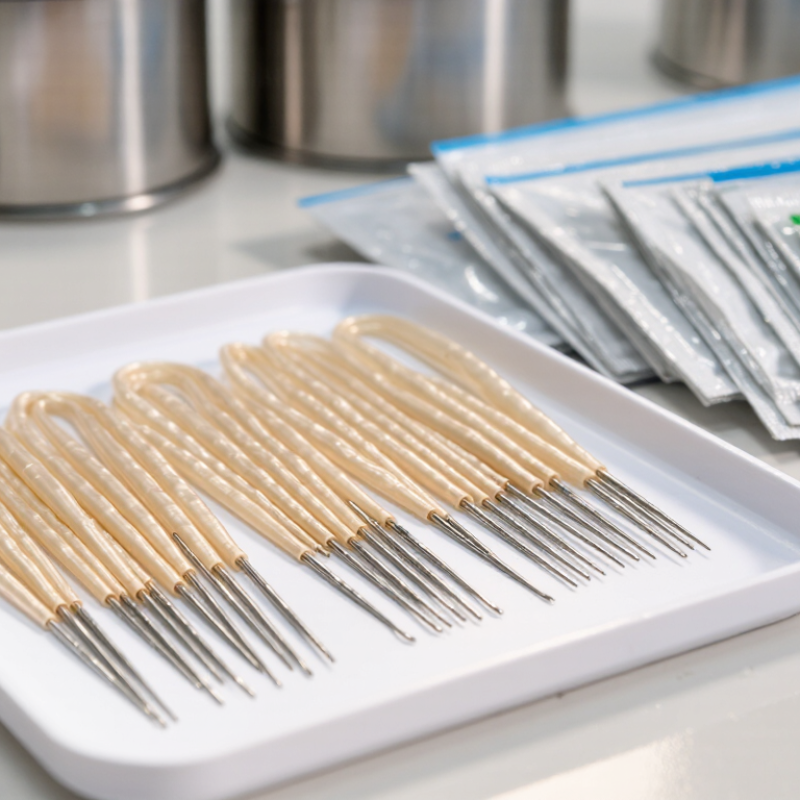
Chromic catgut sutures are absorbable surgical threads made from purified collagen. The collagen usually comes from sheep or bovine tissue. A chromium salt treatment slows enzymatic breakdown and extends support after implantation. Unlike synthetic sutures, catgut gradually loses strength through biological absorption.
The material is commonly used for soft-tissue approximation and ligation where prolonged permanent support is unnecessary. Its smooth, flexible structure can pass through tissue with moderate resistance. However, natural collagen may trigger more tissue reaction than some synthetic alternatives. That difference matters in delicate or highly visible wounds.
The 2024 Fortune Business Insights report valued the global surgical sutures market at approximately USD 4.2 billion in 2023, reflecting continued demand for absorbable closure materials. Yet market growth does not prove that every suture suits every procedure. Buyers should review tensile retention, absorption testing, sterility assurance, packaging integrity, and applicable quality standards before comparing Chinese manufacturers. Small documentation gaps can create large clinical questions.
China’s top 10 chromic catgut suture manufacturers should be evaluated through evidence, not rankings alone. A reliable review examines manufacturing experience, technical staff, and documented quality systems. It also checks whether production records remain traceable from raw material inspection to final packaging. Experience matters when handling natural absorbable materials, because small variations can affect consistency.
Independent testing should confirm tensile strength, absorption behavior, needle attachment, sterility, and packaging integrity. Reviewers should request current test reports, validation records, and shelf-life studies. Factory audits can reveal details that brochures often miss, such as environmental controls, operator training, and batch-release procedures. Regulatory documentation should be complete and verifiable for the intended market. Clinical feedback also deserves attention, although isolated complaints should not define an entire manufacturer. No score is perfect. Some evaluation methods still depend on limited samples or supplier-provided data.
Tips: Compare at least three production batches before making a decision. Ask for lot-specific certificates, not general promises. Check whether the supplier explains deviations openly and provides corrective actions. Study the suture’s handling, knot security, and needle performance under controlled conditions. A low price may hide weaker traceability or shorter supporting evidence. However, higher pricing does not automatically prove better quality. Record every finding, including uncertainties, before selecting a qualified manufacturing partner.
China’s Top 10 Chromic Catgut Suture Manufacturers should be assessed through evidence, not factory size alone. A 2024 Grand View Research report valued the global surgical sutures market at over US$4 billion in 2023, with steady growth expected through 2030. This demand increases pressure on Chinese manufacturers to prove consistency, sterility, and traceability.
Material quality matters. Chromic catgut should show controlled absorption, reliable knot security, and smooth needle attachment. Experienced buyers should review tensile-strength records, sterilization validation, and batch-release testing. ISO 13485 certification can indicate a mature quality system, but it does not replace product-level inspection. Ask for recent audit results.
Small details reveal discipline.
The World Health Organization has reported that hundreds of millions of major surgical procedures occur worldwide each year. That scale makes packaging integrity and supply continuity essential. For China’s top ten manufacturers, useful comparison points include production capacity, export documentation, complaint handling, and technical support. Independent laboratory testing can verify diameter, sterility, and absorption behavior under relevant standards. However, public factory data may be incomplete, and rankings can change quickly. A supplier with attractive pricing may still require closer clinical and quality review. That is not a weakness in the process. It is a necessary reminder that reliable procurement needs repeated evidence, not confident claims.
China’s leading chromic catgut suture manufacturers differ in materials, processing, and quality systems. Most produce absorbable sutures from purified natural collagen. Chromium treatment extends absorption time and improves handling stability. Product ranges commonly include USP sizes from fine to heavy gauges. Some factories also offer reverse-cutting, cutting, and taper-point needles.
Manufacturing capability usually begins with raw-material screening and controlled collagen processing. Strong facilities monitor diameter, tensile strength, needle attachment, sterility, and packaging integrity. Many provide individually packed sutures for hospitals and procedure-specific kits for distributors. Custom labeling, carton design, and batch documentation are also available. Some suppliers support private-label production with flexible order quantities. That helps smaller buyers test demand without excessive inventory.
Quality evidence matters more than polished catalog language. Ask for batch records, sterilization validation, shelf-life data, and applicable quality certificates. A reliable manufacturer should explain storage conditions clearly. It should also describe how nonconforming products are isolated and reviewed. Production lines may look similar, but process discipline varies considerably. No manufacturer is equally strong in every area. A practical evaluation should compare sample consistency, response speed, technical files, and after-sales handling. Brochures can sound precise. Actual performance still needs verification through samples and independent review.
| Rank | Manufacturer Profile | Core Chromic Catgut Products | Raw Material and Finish | Needle and Thread Options | Sterilization and Packaging | Quality and Compliance Capabilities | Typical Application Strength |
|---|---|---|---|---|---|---|---|
| 1 | Manufacturer Profile A | Chromic absorbable sutures in precision-cut and reel-packed formats | Purified collagen-based catgut with controlled chromic treatment and polished surface | Metric and USP sizes; absorbable and non-absorbable needle attachment options; curved and straight needles | EO sterilization; individual sterile packs, foil pouches, and bulk hospital packaging | Lot traceability, tensile-strength testing, diameter inspection, sterility testing, and bioburden control | General soft-tissue closure, ligation, and selected gynecological procedures |
| 2 | Manufacturer Profile B | Plain and chromic catgut sutures with customized needle-thread combinations | Natural absorbable collagen filament with smooth, rounded, and dyed finish options | USP 4-0 to USP 2; taper, reverse-cutting, and conventional cutting needles | Ethylene oxide sterilization and moisture-protective primary packaging | Incoming collagen inspection, process validation, package-integrity checks, and finished-product release testing | Routine surgery, dental soft-tissue work, and veterinary procedures |
| 3 | Manufacturer Profile C | Chromic catgut on atraumatic needles, including double-armed configurations | Absorbable collagen thread with standardized chromic salt treatment for extended absorption | Small to medium diameters; round-bodied, taper-point, and reverse-cutting needle profiles | EO sterilized; peel-open pouches, aluminum foil packs, and customized carton labeling | Needle attachment strength, knot-pull testing, absorption monitoring, and visual-defect inspection | Mucosal repair, subcutaneous closure, and ligation where absorbability is preferred |
| 4 | Manufacturer Profile D | Standard chromic catgut, customized suture lengths, and procedure-specific sets | Sterile natural collagen filament with uniform coating and controlled handling characteristics | USP and metric sizing; half-circle, three-eighths-circle, and five-eighths-circle needles | Validated EO cycle; single-use packaging with batch and expiration identification | Documented quality-control procedures, environmental monitoring, and sterilization-batch records | Hospital surgical departments, outpatient procedures, and contract-manufacturing programs |
| 5 | Manufacturer Profile E | Fine-gauge chromic catgut for delicate tissue approximation | Refined collagen filament with low-profile surface and controlled coloration | USP 6-0 to USP 3-0; ophthalmic-style and microsurgical needle geometries available by specification | Sterile EO processing; humidity-controlled packaging and protective foil presentation | Fine-diameter measurement, needle sharpness checks, knot security, and package seal testing | Delicate soft-tissue procedures, dermatological closure, and selected ophthalmic applications |
| 6 | Manufacturer Profile F | Heavy-gauge chromic catgut and ligature configurations | Higher-diameter collagen thread with chromic treatment and reinforced handling properties | USP 2-0 to USP 2; blunt, taper, and cutting needle options; loop and tie configurations | EO sterilization; individual packs and larger-volume clinical packaging | Tensile retention, knot-pull strength, needle-to-suture attachment, and sterilization validation | Ligation and closure requiring comparatively higher initial handling strength |
| 7 | Manufacturer Profile G | Chromic catgut for export-oriented private-label and OEM programs | Natural collagen absorbable suture with configurable lengths, colors, and labeling | Common USP sizes; custom needle curvature, point type, and thread length available to specification | EO sterilized; multilingual labels, customized cartons, and serialized batch documentation | OEM document support, batch records, certificate-of-analysis preparation, and export inspection procedures | International distributors, private-label medical-device programs, and institutional procurement |
| 8 | Manufacturer Profile H | Chromic catgut in pre-cut, ligature, and suture-pack formats | Collagen-based absorbable filament with controlled diameter and smooth surface treatment | Metric sizing; taper, cutting, and reverse-cutting needles in standard surgical curvatures | Validated EO sterilization; sterile barrier packaging and moisture-resistant secondary cartons | Sterility assurance, dimensional inspection, visual examination, and shelf-life monitoring | General surgery, obstetrics and gynecology, dental surgery, and veterinary use |
| 9 | Manufacturer Profile I | Chromic catgut with customized suture lengths and needle specifications | Absorbable animal-derived collagen filament treated to provide slower absorption than plain catgut | Fine through heavy sizes; straight and curved needles with taper or cutting points | EO sterilization; single-use sterile pouches and institutional bulk packs | Raw-material traceability, tensile testing, sterility testing, and packaging integrity verification | Soft-tissue approximation and ligation in procedures using natural absorbable materials |
| 10 | Manufacturer Profile J | Chromic catgut products for domestic medical supply and customized clinical orders | Sterile collagen suture with chromic processing, polished finish, and controlled absorption profile | USP and metric sizes; standard surgical needles with optional custom attachment specifications | EO sterilization; peelable sterile pouches, cartons, and traceable batch coding | Process inspection, final-release testing, complaint traceability, and controlled document management | Routine hospital surgery, local medical distributors, and veterinary applications |
Note: Manufacturer profiles are anonymized. Product availability, regulatory status, sterilization method, and customization scope should be verified directly with each supplier before procurement.
Choosing a reliable Chinese chromic catgut suture supplier requires more than comparing catalog prices. Ask how the supplier controls animal-derived materials, chromium treatment, cleaning, and drying. Request batch-level traceability, not a general quality statement. A dependable factory should provide ISO 13485 certification, product specifications, sterilization records, and current test reports. Check whether documents identify the same product size and manufacturing site.
Practical evaluation should include samples. Inspect the suture surface under magnification. It should look even, without loose fibers, dark spots, or stiff sections. Test knot security, needle attachment, tensile strength, diameter, and absorption performance through an independent laboratory when possible.
Ask for packaging samples too. The inner pouch should remain sealed after handling. Labels should show the lot number, expiry date, sterilization method, and storage conditions. Keep written answers. Verbal promises are easy to forget.
Visit the factory, or arrange a live video audit. Observe clean areas, material flow, calibration labels, and finished-goods quarantine. Ask how nonconforming batches are isolated and investigated. A serious supplier should explain corrective actions without hiding uncomfortable details. I would compare three recent lots, not one attractive sample. One weakness remains: supplier websites may show outdated certificates or broad product claims. Verify critical documents with issuing bodies and request references from hospitals or distributors with similar volumes. Leave room for reassessment; staff, equipment, or sterilization contractors can change.
Compare material quality, sterility, traceability, capacity, documentation, and technical support. Factory size alone proves little. Rankings can change.
Look for controlled absorption, reliable knot security, smooth needles, and consistent diameter. Needle attachment should remain secure during handling.
Request tensile-strength results, batch-release tests, sterilization validation, shelf-life data, and recent audit findings. Evidence matters.
No. It suggests a mature quality system, but it does not replace product-level inspection or independent testing.
Test diameter, sterility, tensile strength, needle attachment, and absorption behavior under relevant standards. Repeat testing when results seem unusually perfect.
Check individual pouch seals, labeling, batch numbers, expiry information, and carton strength. A damaged seal can undermine an otherwise acceptable product.
Some provide custom labels, carton designs, procedure kits, and flexible quantities. Smaller trial orders can reduce excess inventory and expose inconsistencies.
Ask how defective batches are isolated, investigated, documented, and replaced. Complaint handling reveals process discipline. Brochures cannot answer everything.
Not always. Public data may be incomplete, and supplier performance can vary by batch, product size, and delivery period. Independent review remains sensible.
This article provides a practical overview of Chromic Catgut Sutures, including their material characteristics, absorption behavior, common medical applications, and the role of chromium treatment in improving handling and wound-support performance. It also explains how Chinese manufacturers can be evaluated through factors such as product quality, manufacturing consistency, sterilization control, regulatory documentation, customization options, production capacity, and export experience.
The guide introduces ten leading categories of Chinese manufacturers without focusing on brand names, highlighting their typical products, technical capabilities, packaging services, and supply advantages. It concludes with a clear checklist for selecting a reliable Chinese catgut suture supplier, including factory verification, quality-control procedures, certifications, sample assessment, communication efficiency, delivery reliability, and after-sales support. This information is intended to help buyers compare suppliers systematically and make informed sourcing decisions.