UHMWPE Polyethylene Sutures are attracting attention in orthopedic and soft-tissue repair, where high tensile strength and resistance to abrasion can matter at the knot and along the stitch line. Yet choosing a supplier takes more than comparing product descriptions. Buyers should examine fiber grade, braid construction, needle attachment, sterilization method, packaging integrity, and supporting test data. Small details matter. A stiff strand may handle differently through tissue; a poorly matched needle can complicate placement.
Industry reports provide useful context, but not a complete answer. Grand View Research’s surgical-sutures market analysis and Fortune Business Insights’ market coverage examine broader categories, including materials, procedures, and end users. Their market estimates describe the wider suture sector, not a separately measured UHMWPE segment. That distinction matters when assessing manufacturers in China: general market growth should not be mistaken for verified demand for this specific material. Product-level evidence is more useful, including tensile-strength results, dimensional consistency, traceability, and quality-system documentation. Ask for current records, not only a polished catalog.
A further caution: I could not verify a published quotation from a named specialist that specifically addresses UHMWPE sutures, so attributing one here would risk misrepresentation. This guide therefore focuses on checkable manufacturer evidence and clear comparison criteria. It is not a ranking based on market share. Some supplier details may also change, and that deserves a second look before procurement.
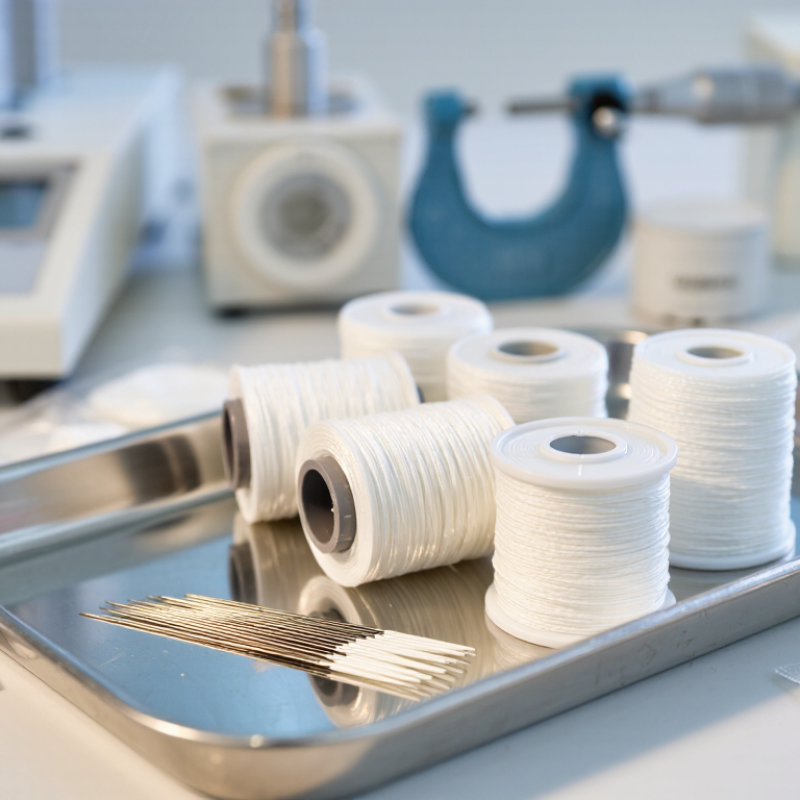
UHMWPE sutures are made from ultra-high-molecular-weight polyethylene fibers. The material offers high tensile strength with relatively little stretch. Many designs use a braided structure, creating a flexible cord that surgeons can handle and knot. Construction varies, so performance should be checked against the product’s technical specifications. Small differences matter.
These sutures are used in selected orthopedic procedures, including tendon, ligament, and other soft-tissue repairs. Their strength can support demanding repairs, but strength alone does not determine suitability. Braid pattern, coating, needle attachment, and knot security also affect handling. A suture that feels secure in one technique may feel less intuitive in another; that trade-off deserves attention.
Tips: Check the labeled intended use, sterilization details, and documented mechanical properties before procurement. For clinical decisions, follow qualified professional judgment and the relevant product instructions. Avoid assuming that all UHMWPE sutures behave alike; their structure and handling can differ.
UHMWPE sutures begin with carefully controlled polymer processing. The material is formed into high-strength fibers, then stretched to align its molecular structure. Manufacturers may braid or otherwise construct the fibers, attach a surgical needle, and inspect the finished device. Small process changes can affect flexibility, surface feel, and tensile performance. Details matter.
Quality checks should cover more than a single strength result. Testing may assess diameter, breaking force, needle attachment, braid consistency, and package integrity. Biocompatibility and sterilization processes also require appropriate evaluation and validation. A clean-looking suture is not proof of a controlled process. That distinction is easy to miss.
In China, regulatory pathways depend on the device’s intended use and classification. Manufacturers must follow applicable National Medical Products Administration requirements, maintain quality-system controls, and support registration or filing with relevant technical evidence. Buyers comparing Chinese manufacturers can request current authorization documents, test reports, and traceability information for production lots. Verify scope and dates; paperwork can be incomplete. Even strong documentation deserves a closer look.
China Top 10 UHMWPE Polyethylene Sutures Manufacturers?
Criteria for Evaluating Chinese UHMWPE Suture Manufacturers
A supplier list is only a starting point. For UHMWPE sutures, assess the product configuration: filament construction, diameter range, needle attachment, coating, and packaging. Request specifications for a specific product model, not just a general catalog. Small details matter. A needle mismatch or inconsistent braid can affect handling and knot security.
Review the evidence behind quality claims. Request batch traceability, incoming-fiber controls, in-process inspection records, and finished-product test methods. Compare tensile-strength and knot-pull results only when testing procedures are clearly stated. Ask how deviations are investigated and corrective actions documented. Good answers are specific. Vague assurances are not.
Manufacturing capacity matters, but consistent output matters more. Examine production areas, equipment maintenance, operator training, and packaging controls during an audit. Confirm that sterilization and shelf-life evidence applies to the exact product and packaging configuration. Evaluate samples using a consistent, documented protocol with qualified clinical and procurement teams. One limitation remains: a polished sample cannot prove routine batch consistency. No checklist is perfect. Recheck evidence after design or process changes, and record unresolved gaps before qualification.
Suggested scorecard weights for comparing manufacturers: material traceability and mechanical performance receive the highest emphasis, followed by biocompatibility, sterilization, and quality-system evidence. These are illustrative evaluation weights—not audited scores, rankings, or verified data for any manufacturer.
A useful profile of ten UHMWPE suture manufacturers in China should compare production evidence, not just catalogue claims. MarketsandMarkets estimated the global surgical sutures market at USD 3.5 billion in 2023, with a projected 5.0% annual growth rate through 2028. This is a broad market estimate, not a China-specific measure or proof of UHMWPE demand. Still, it signals why buyers should examine capacity and quality controls closely.
For each manufacturer, check whether product information specifies filament construction, braid consistency, needle attachment, and tensile-strength testing. Ask for technical data, batch traceability, and evidence that sterilization processes are validated. A clean sample package and clear labeling are useful details, but they cannot replace independent testing. That matters. Compare the same suture size and test method across suppliers; otherwise, performance figures may not be comparable. Not enough, though. Public profiles often leave gaps in raw-material sourcing and long-term performance data, so those points deserve direct questions. A ten-company overview is most useful when it separates documented capabilities from claims that still need verification.
Data note: This table does not rank or identify ten individual manufacturers. Supplier-specific capabilities and product specifications should be confirmed against current manufacturer documents; the entries below summarize verifiable product characteristics and due-diligence points without inventing company data.
| No. | Profile area | Reliable product information | Supplier-specific information to verify |
|---|---|---|---|
| 1 | Material | UHMWPE sutures use ultra-high-molecular-weight polyethylene fibers. Suture composition and any additional fiber materials vary by product. | Material composition, technical specifications, and applicable product documentation. |
| 2 | Absorption | UHMWPE sutures are generally classified as nonabsorbable; the finished device’s labeling is authoritative for a specific product. | Labeled absorption classification and intended duration of support. |
| 3 | Construction | Braided constructions are used for many UHMWPE surgical sutures; construction details are product-specific. | Braid structure, coating or treatment, and applicable test methods. |
| 4 | Typical clinical use | UHMWPE sutures are commonly associated with orthopedic soft-tissue repair applications. Indications differ by device and jurisdiction. | Approved or cleared indications in the target market and the product’s instructions for use. |
| 5 | Suture size | Surgical suture sizes may be stated using recognized size conventions, including USP sizing; available sizes vary among products. | Size range, diameter specifications, and the standard used for each size. |
| 6 | Color | Suture color is a product-design and labeling detail; it should not be assumed to be the same across manufacturers or product lines. | Available colors, colorant information, and labeling for the supplied SKU. |
| 7 | Needle options | Sutures may be supplied with different needle shapes, points, and attachment configurations, depending on the product. | Needle material, geometry, attachment type, and available suture-needle combinations. |
| 8 | Sterilization | Sterilization method is specific to the finished device and must be stated in its labeling and technical documentation. | Validated sterilization method, sterility assurance documentation, and any stated restrictions. |
| 9 | Packaging and shelf life | Sterile surgical sutures are supplied in product-specific packaging. Shelf life and storage conditions are defined by the manufacturer’s labeling. | Packaging configuration, expiry period, storage requirements, and package-integrity evidence. |
| 10 | Quality and regulatory status | Quality-system certification and regulatory authorization are not interchangeable; status must be checked for the specific legal manufacturer, device, and destination market. | Current certificates, registration or authorization details, legal manufacturer identity, and traceability records. |
A top-10 comparison of Chinese UHMWPE polyethylene suture manufacturers should look beyond catalogue size. Check filament construction, needle options, available sizes, colors, and packaging. Ask whether specifications remain consistent across samples and production batches. A broad range is useful, but it does not prove suitability for a particular procedure. Compare products with their approved labeling and technical documentation.
Certification evidence deserves careful review. Request current certificates, scope pages, issuing-body details, and expiry dates. Confirm that each document covers the relevant product category and manufacturing site. Quality-system certificates and product registrations are not interchangeable. Export capability also shows in practical details: traceable batch records, realistic lead times, clear labeling, and timely document support for destination-market review. Verify approval claims with the relevant authority. Some comparisons remain imperfect when public information is limited.
Tips: Request sample specifications and a recent batch record. Check export documents against the destination market’s requirements. Details matter. A polished brochure is not enough.
Polymer is processed into strong fibers, then stretched to align its molecular structure. Fibers may be braided, fitted with a needle, and inspected. Small process changes can affect flexibility and strength.
Checks may cover diameter, breaking force, needle attachment, braid consistency, and package integrity. Biocompatibility and sterilization also need suitable evaluation. One strength result is not enough.
Request current authorization documents, relevant registrations or filings, and technical evidence. Check the product scope, manufacturing site, and dates. Paperwork can have gaps.
Compare the same suture size and test method. Review filament construction, needle options, specifications, and batch consistency. Catalogue breadth alone proves little.
Ask for test reports, batch traceability, and recent production records. Independent testing can help assess samples. A clean package is useful, but not proof of process control.
Check current certificates, scope pages, issuing-body details, and expiry dates. Confirm they cover the relevant product and manufacturing site. Certificates are not interchangeable.
Look for traceable batch records, clear labeling, realistic lead times, and responsive document support. Verify approval claims with the relevant authority. Some details may remain unclear.
Usually not. Public information may omit raw-material sourcing and long-term data. Ask direct questions, and treat unsupported claims cautiously. Even careful comparisons have limits.
This article explores UHMWPE Polyethylene Sutures, focusing on their material properties, braided or structured designs, and uses in medical procedures where high strength and reliable handling are important. It outlines how these sutures may be manufactured in China, including key production steps and the quality controls and regulatory requirements that manufacturers need to consider. The discussion also explains how buyers can assess manufacturers by reviewing factors such as production capabilities, product consistency, documentation, certifications, and experience serving medical markets.
The article then presents profiles of ten Chinese manufacturers, offering a framework for comparing their product ranges, quality credentials, and export capabilities. Rather than endorsing any particular supplier, it highlights practical questions for evaluating suitability, including available suture configurations, supporting technical information, and the ability to meet customer requirements. Together, these topics provide readers with a clear starting point for understanding the Chinese UHMWPE suture market and making informed comparisons.